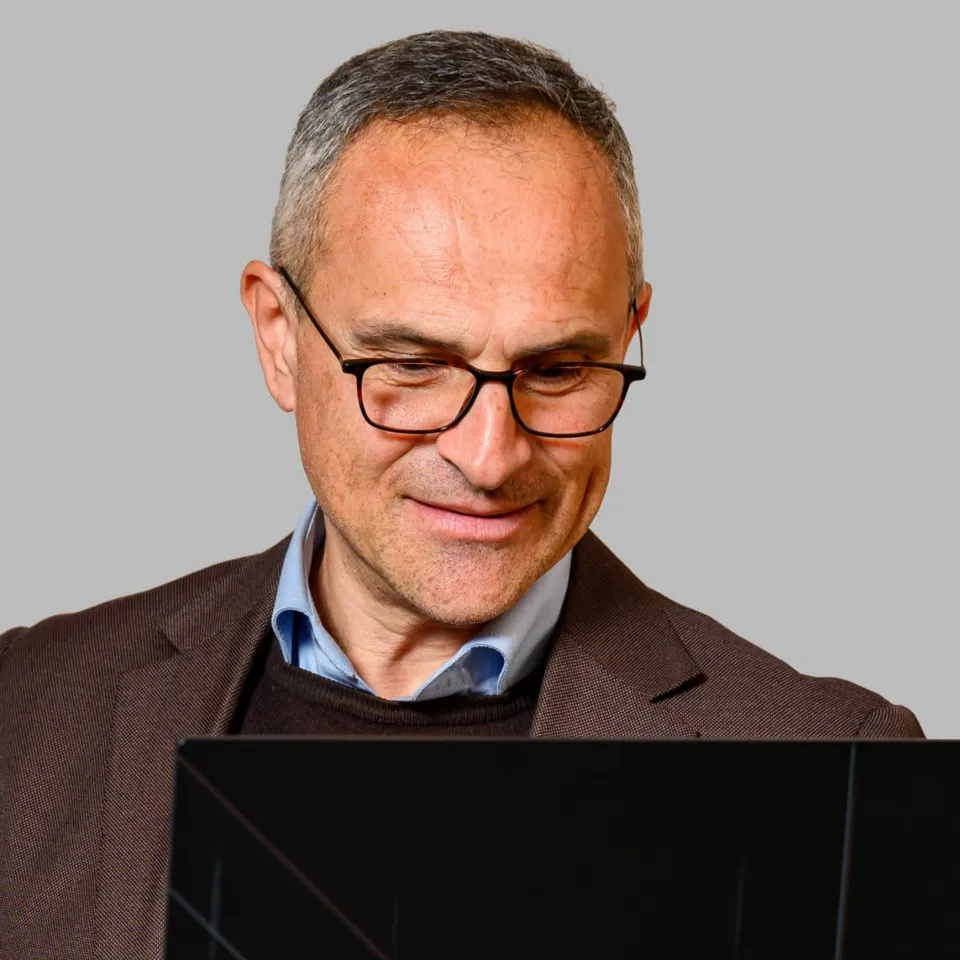
Every now and then on our blog we like to talk with members of our team to bring out not only our professional skills but also the people behind them. Because beyond technologies, platforms and programming languages, behind our software house there are people with a story and a soul worth sharing with the outside world. It is also thanks to them that we believe we can stand out.
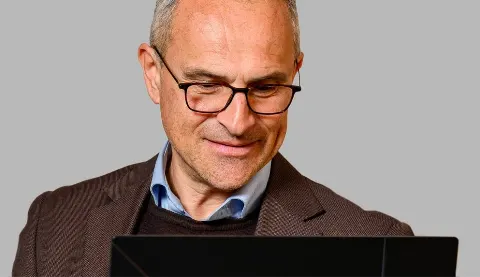
This time, after Max, Antonio and Fabrizio, we interview Alessandro Di Giorgio, our UI designer and test manager. But let's have him explain what this job involves.
The interview, which is really a very friendly chat, is once again by our marketing and communications manager Leo Cascio. Enjoy the read.
_____
Leo: Hi Alessandro. First of all congratulations, since after a period as an external collaborator you have recently joined ESSE I in-house, where you officially have two roles: UI designer and test manager.
Can you tell us more about what your job involves?
Alessandro: Hi Leo. Thanks! At ESSE I I take care of the graphics and usability of our applications, but also of the beta testing of everything we develop. In practice, I check that the structures and graphical interfaces of our software are as usable as possible, and also that everything works properly from a functional point of view. I am a so-called "holistic" collaborator, because I look at the quality of the product from every angle, pointing out to the development team everything that can be improved and simplified, focusing on the benefits for the end user.
But that's not all, because I also help the team build mobile applications on the Delphi platform: basically I support the head of ESSE I's Delphi area, who in turn is technically responsible for the range of management applications for sales networks.
Then again, wanting to make use of my studies (I have a law degree), lately I have also been trying to move into the technical and administrative area where, it seems, my advice on contracts is particularly appreciated.
L: So I understand you are a "jack of all trades", a "multipotentialite" working on several fronts. Am I wrong?
A: You're not wrong, I am a bit of a handyman. Of course my main duty is to make sure our software provides, visually and functionally, the best possible answer to users' needs, so UI design and beta testing remain central for me. But since ESSE I is a small company (although growing, as it is gradually involving more and more specialised collaborators), I can't avoid helping out in other areas too, such as legal and administrative matters.
L: For which there is an external legal office anyway...
A: Sure, Max relies on a law firm that does the bulk of the work. But having a good grounding in digital forensics, which was my specialisation both through my studies and through what I did before joining ESSE I, I contribute in an area that is not about coding.
Also because I am not a coder, and maths has never been my strong point. So I play other cards...
L: Quite right: in a software house not everyone has to be a nerd expert in maths and coding; you also need people like you (I understand you very well, since I belong to the same "category"). A software house also needs people with a less scientific and more humanistic bent, people who by education and character are "closer" to people, to their problems and needs (which are often not even rational). And perhaps also to communication, marketing and sales.
A: Look, in the past I have been a salesman too, Leo. From 2001 to 2010 I ran an IT services business here in Cosenza. Even though I had collaborators, I basically did everything. Just as happens when you are small and have to handle lots of different things yourself, partly to keep costs down. Of course you should delegate, and I did, but at least at the beginning there is no escaping "doing a bit of everything"...
L: I understand, I did the same in the past before "positioning" myself as a freelancer.
But going back to UI design and testing, I'd like to ask you a question that I think many readers of our blog ask themselves, or perhaps those who would like to entrust ESSE I with building a top-notch application.
Alessandro, how do you create an effective user interface? How do you make software usable?
A: First of all it must be easy and intuitive, as uncomplicated as possible. People have a minimal attention span; they don't want to rack their brains to understand how to do things. So anyone doing this job has to take on the burden of solving doubts and problems before they arise. This will make the software more complex inside, but on the outside the goal is to reduce its impact on the user. Which is one of the best-known paradoxes of technology.
L: Yes, and unfortunately it makes less tech-savvy people believe that if a technology is simple on the outside it is simple inside too. But that's not the case; often it's exactly the opposite. Meanwhile there is the hard and often misunderstood work of programmers and related roles, who make sure that the "mental effort" for whoever uses a platform is kept to a minimum.
So what methods or approaches do you use at ESSE I to achieve this?
A: I could tell you about process optimisation tools, feedback from all our previous clients and experience in the field, but I'll simply answer "we ask ourselves questions".
We try to put ourselves in the shoes of the people who will use the interfaces, to understand who they are, what their wishes and needs are, what might be going through their minds. I am the one responsible, but in reality we are all trying to do it at ESSE I. The whole team is now involved in putting the person, the user, at the centre of their work. This can only come from the greatest and most complete effort to understand.
L: Perhaps from developing soft skills like empathy!
But what about the technical side? And in terms of organisation and time management, how does your work function? How does this job work?
This reminds me of the second episode of the "Compresse I" podcast with Max Aiello, where we talked mainly about this, but I'd like to hear it directly from you.
A: We have an internal ticket system in which each of us writes a report on the task they have done. Team members read it and leave feedback with their point of view. For example, when the ticket concerns usability, they usually ask me the classic question: "I've implemented function X, can you test it and tell me what you think?". I reply and an exchange begins that can last days and ends only when it becomes "idiot-proof".
The fact that I am not a programmer, and therefore look beyond the technical aspects and focus on "what you see and click", obviously helps, because it lets me find any flaws by using my natural inclination.
L: You're like a good guinea pig, your thinking isn't influenced by preconceptions...
A: Yes, because I'm an "ignoramus". In fact I'm a beta tester loaded with tickets. One who sometimes even finds the typos...
L: But let's change subject: since nobody talks about anything else these days, I'll ask you too: what do you think of using generative artificial intelligence in coding?
A: When ChatGPT came out I was one of the first in the company to try it. It's true that I'm an ignoramus, but a curious one. I've been passionate about computers since I was a child, like Max and pretty much the whole internal and external team...
L: ...present! But maybe better not to start on "1980s nerd gadgets", or we'll be here all night...
A: Right. About AI, I was saying that the first time I used it, I asked ChatGPT to translate a client list into Delphi code; the list contained a series of information with a certain structure and specific calculation rules. "It" translated everything into code in a few moments, leaving me speechless. I called Max and other colleagues and said: "Look at this, isn't it amazing?"
Except that when I ran that code, I soon realised that it didn't work at all.
I kept "playing" with ChatGPT, and I still do, and lately also with Google Bard, but it's often a constant process of reporting imperfect code, to which the AI replies: "You're right, I apologise for the mistake". I have a whole history full of these exchanges.
So for me AI is interesting, partly also useful, but still too embryonic, not yet reliable.
L: I often say: "AI is an exceptional tool in the hands of those who are competent, but dangerous in the hands of those who are not". What do you think?
A: Here in Cosenza we have a saying: the tie makes the gentleman. I mean, to me it seems more like "appearances can be deceptive", "smoke and mirrors".
L: I think it can help speed up writing; as a content manager I admit I sometimes use it for ideas or to draft an outline. But it is essential to do so with common sense and competence, first of all avoiding using what the AI gives us without a critical eye. I wonder whether it can also be useful in coding, when the various tools give us lines of code.
I think: maybe they are useful for learning, but not for production. Right?
A: AI is fine if you are happy to settle, perhaps. But not if you are aiming for quality. At ESSE I we have chosen precisely this path, starting an academic study of the evolution of AI. We are working on how best to integrate it into our future. For our clients' future, we already do it.
L: I agree, Alessandro. It's no coincidence that Max said in the podcast that at ESSE I it is used, yes, but still little, unless a client asks us to develop it or integrate it into their projects! In that case the software house is ready.
Before we say goodbye, one last question, Alessandro, because I think it helps show the outside world the "why" of this company, that is, its human dimension. I asked Antonio and Fabrizio too.
How did you meet Max, the CEO of ESSE I? And why did you decide to join ESSE I?
A: I met him through Fabrizio, whom I have known for thirty years. He introduced us and asked me if I'd like to join Max and his team. The "chemistry between us" did the rest: as with Fabrizio, we became great friends; it's as if we've known each other all our lives, even though only two years have passed. But the credit goes above all to Max, a person with a very strong sensitivity, one that goes beyond.
L: True, a CEO with rare humanity...
A: Even "naive" in some ways. In the sense that his generosity unfortunately sometimes attracts people who take advantage.
L: Yes. But I believe that in the long run being and behaving like the good person he is will win. Like the "harmony" that lives in him and with which he has permeated the whole of ESSE I.
Anyway, can I tell you something, Alessandro? I have the impression that you are a kind of "mediator" between Max and Fabrizio, people with similar values and passions (otherwise they wouldn't be friends or work together) but with somewhat different characters and ways of thinking. Am I wrong?
A: More than a mediator, I act like a parent. But one of the annoying kind...
Jokes aside, I do tend to mediate, that's true. And I think I'm good at it, helping keep the atmosphere here at ESSE I harmonious.
L: And playful too. Just ask the garden gnome Max gave you for your last birthday...
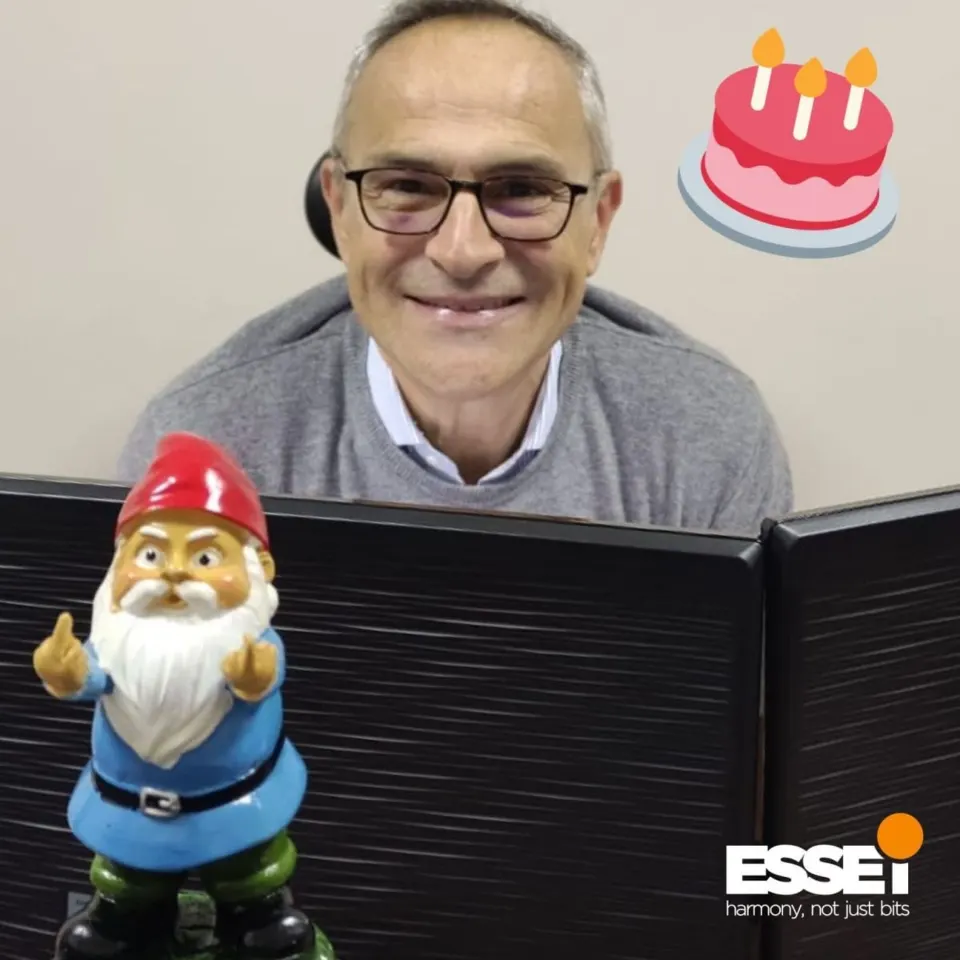
A: A much appreciated gift. Unlike this "interview" of yours, as if I were somebody important! Leo, didn't you have anything better to do with your life than waste time with someone like me?
_____
That's how we said goodbye to Alessandro.
Perhaps we should have reminded him (though Alessandro knows it well) that getting closer to people is never a waste of time. In the end we are all colleagues in this, each with our own approaches, methods and tools.
After all, what is a good UI if not "trying to be more human"?
Until our next chat with the team!