Many companies believe they know how much they earn from a job.
They look at turnover, subtract a few obvious costs and think they have a margin.
But what emerges is often only a partial picture.
The real question is not:
"How much did we invoice?"
The real question is:
"How much was really left after taking into account all the resources, time, direct costs, indirect costs and operational variances?"
For many service, consulting, building services, technical support, make-to-order or project-based companies, real margin is one of the most important indicators for understanding whether a piece of work was truly profitable.
Yet it is also one of the hardest figures to calculate correctly.
Why apparent margin can be misleading
A job can look profitable because it generates good turnover.
For example:
- quote approved by the client: €30,000;
- estimated material costs: €8,000;
- planned man-hours: 200;
- expected margin: apparently attractive.
But what happens if, during execution:
- actual hours become 310;
- more expensive resources than planned are involved;
- work that was not quoted is carried out;
- there are trips, emergencies, rework or extra support;
- the client asks for changes that are not recorded;
- invoicing does not correctly follow work progress;
- some indirect costs are not allocated to the job?
In this case the expected margin can shrink drastically, to the point of turning an apparently positive job into a loss.
The problem is not only financial.
It is managerial.
If we do not measure real margin correctly, we risk making the wrong decisions: accepting unprofitable work, underestimating future quotes, overloading our best resources or failing to understand which clients really generate value.
What is the real margin of a job
The real margin of a job is the difference between what the company collects or invoices and all the costs actually incurred to carry out that work.
Put simply:
Real margin = Actual job revenue - Actual job costs
In practice, however, the calculation is more complex.
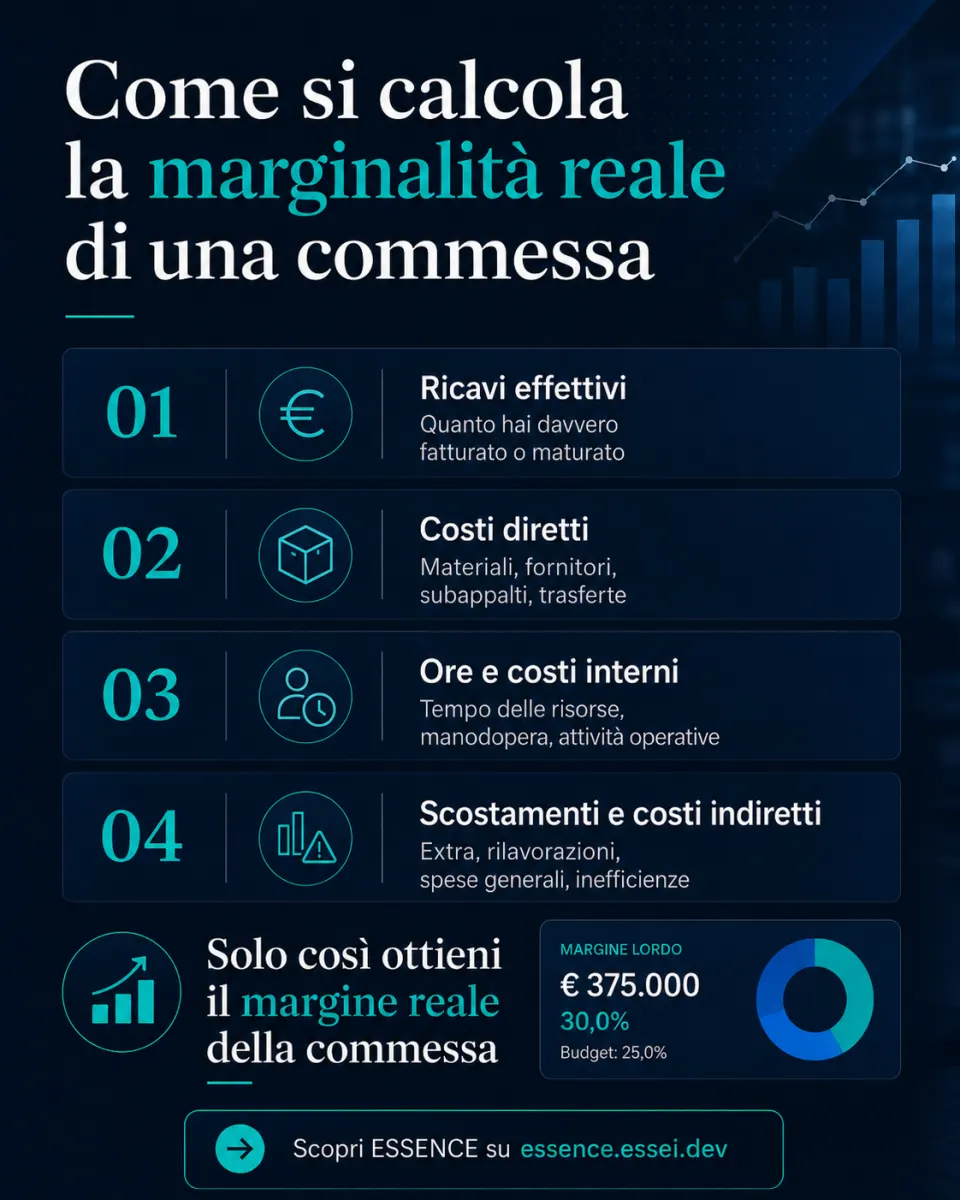
You need to distinguish at least between:
Planned revenue
The revenue estimated at the quote or contract stage.
Actual revenue
The revenue actually invoiced or accrued according to progress.
Direct costs
The costs directly linked to the job: materials, suppliers, subcontracting, external consultants, licences, rentals, travel.
Cost of internal staff
One of the most underestimated elements. Every hour worked by an internal resource has a real cost to the company, which must be allocated to the job.
Indirect or overhead costs
Costs that are not always immediately visible: administration, coordination, sales management, infrastructure, tools, software, internal support, meetings, control activities.
Variances
The differences between what was planned and what actually happened: more hours, more materials, delays, rework, extra work not invoiced.
Only by putting all this data together can you get a reliable view.
The role of man-hours in calculating margin
In service companies and companies that work on a job basis, time is often the most important cost.
The problem is that time is often managed informally.
A technician goes on site.
A consultant solves a problem.
A project manager attends a meeting.
A salesperson keeps following the client after the deal is closed.
An administrator handles documents, invoices, progress reports or contracts.
All these activities have a cost.
If they are not recorded, the margin is distorted.
That is why it is essential to link the job to:
- activity planning;
- timesheets;
- hourly cost of resources;
- roles involved;
- planned and extra activities;
- work progress;
- invoicing.
An unrecorded hour is an invisible cost.
And an invisible cost can turn into a silent loss.
Planned margin and final margin
A good management control system should allow you to constantly compare:
Planned margin
The margin estimated at the offer or planning stage.
Updated margin
The margin recalculated as the job progresses.
Final margin
The margin calculated once the job is complete.
This comparison is decisive.
If a job starts with a planned margin of 30% but drops to 18% after the first month, the company must notice immediately.
Not at the end.
Acting in time can mean:
- renegotiating extra work;
- stopping unplanned requests;
- correcting the plan;
- moving resources;
- revising timescales;
- improving invoicing based on progress;
- preventing the project from becoming uneconomic.
Margin control is not just about "doing the sums".
It is about steering the job while it can still be corrected.
A practical formula for calculating real margin
A useful formula could be:
Real margin = Actual revenue - Direct costs - Cost of internal hours - Allocated indirect costs - Extra costs
To get the margin percentage:
Margin % = Real margin / Actual revenue x 100
Simplified example:
- actual revenue: €50,000;
- materials and suppliers: €14,000;
- internal hours: €18,000;
- travel and extra costs: €3,000;
- allocated indirect costs: €4,000.
The real margin will be:
50,000 - 14,000 - 18,000 - 3,000 - 4,000 = €11,000
The margin percentage will be:
11,000 / 50,000 x 100 = 22%
The interesting figure is not just the 22%.
The real value lies in understanding why that margin is 22%:
- was it expected?
- has it improved?
- has it got worse?
- which costs reduced it?
- which activities were not invoiced?
- which resources had the greatest impact?
- is the client really profitable?
- should a similar job be offered again at the same price?
These questions turn financial data into strategic information.
The most common mistakes in calculating margin
Many companies make recurring mistakes.
1. Considering only external costs
Materials and suppliers are easy to see.
Internal hours, on the other hand, are often underestimated.
But staff have a real cost and it must be allocated correctly.
2. Not distinguishing between planned and actual
The quote is a forecast.
The actual job is something else.
Without comparing budget and actuals, it is impossible to improve.
3. Not recording extra work
Client requests during the project may seem small.
But added together they can completely erode the margin.
4. Not linking invoicing to progress
If production moves forward but invoicing lags behind, the company risks cash-flow problems and loss of control.
5. Not having up-to-date data
A final report is useful, but it often arrives too late.
Margin should be monitored during execution.
Why an ERP can make the difference
Calculating real margin with separate Excel sheets, emails, manual notes and data spread across different departments is possible, but quickly becomes complex.
The risk is having incomplete, outdated or non-comparable data.
An ERP designed for job-based management control, on the other hand, lets you connect in a single flow:
- quote;
- contract;
- activity planning;
- resources involved;
- timesheets;
- direct costs;
- suppliers;
- progress reports;
- invoicing;
- work progress;
- margin;
- KPIs and management dashboards.
In this way the job is no longer seen just as a set of operational activities, but as a cost and revenue centre that can be measured in real time.
ESSENCE: management control and job margin
ESSENCE is the ERP developed by ESSE I to help companies manage processes, jobs, resources, contracts, operational activities and management control.
One of its most important features is the ability to analyse job margins by integrating data that often remains separate within companies:
- hours worked;
- resource costs;
- activity progress;
- external costs;
- invoicing;
- margin by client;
- margin by project;
- margin by area or department;
- variances between planned and actual.
The advantage is not just having a final figure.
The advantage is being able to read how the job is going while it is still in progress.
Because knowing the margin at the end of the project is useful.
But knowing it during the project can make the difference.
Conclusion
The real margin of a job is not calculated by looking only at turnover.
It is calculated by bringing together time, costs, resources, activities, variances, progress and invoicing.
A company that really knows the margin of its jobs can decide better, sell better, plan better and grow on a more solid footing.
Management control is not an administrative task.
It is a strategic tool.
Find out how ESSENCE can help you control the real margin of your jobs and turn operational data into business decisions.
Visit: https://essence.essei.dev