Service companies are often used to working under pressure.
Sites to follow, technicians to coordinate, clients to update, suppliers to manage, materials to order, urgent call-outs, scheduled maintenance, final accounts, invoices, deadlines, documents, safety, subcontracting, in-house and external staff.
Anyone working in sectors such as building services, construction, maintenance, technical support, facility management, consulting or professional services knows that a company's value does not lie only in what it sells.
The real value lies in the ability to organise work well.
Yet many companies grow, win clients, take on more jobs, hire staff, open new offices or run more sites, but keep working with tools that were created when the organisation was much smaller.
Excel, emails, WhatsApp messages, phone calls, shared files, personal notes and software that does not talk to each other can work for a while.
Then the problems start.
Information gets scattered.
Costs are not clear.
Activities are not recorded against the job.
Quotes are not linked to the job.
Hours worked are not recorded correctly.
Documents are not always up to date.
Management finds out too late that a job has lost margin.
The point is this: many companies do not have a problem of technical skills.
They have a problem of control, method and data integration.
Let's look at some of the most common mistakes.
1. Managing jobs without a single view
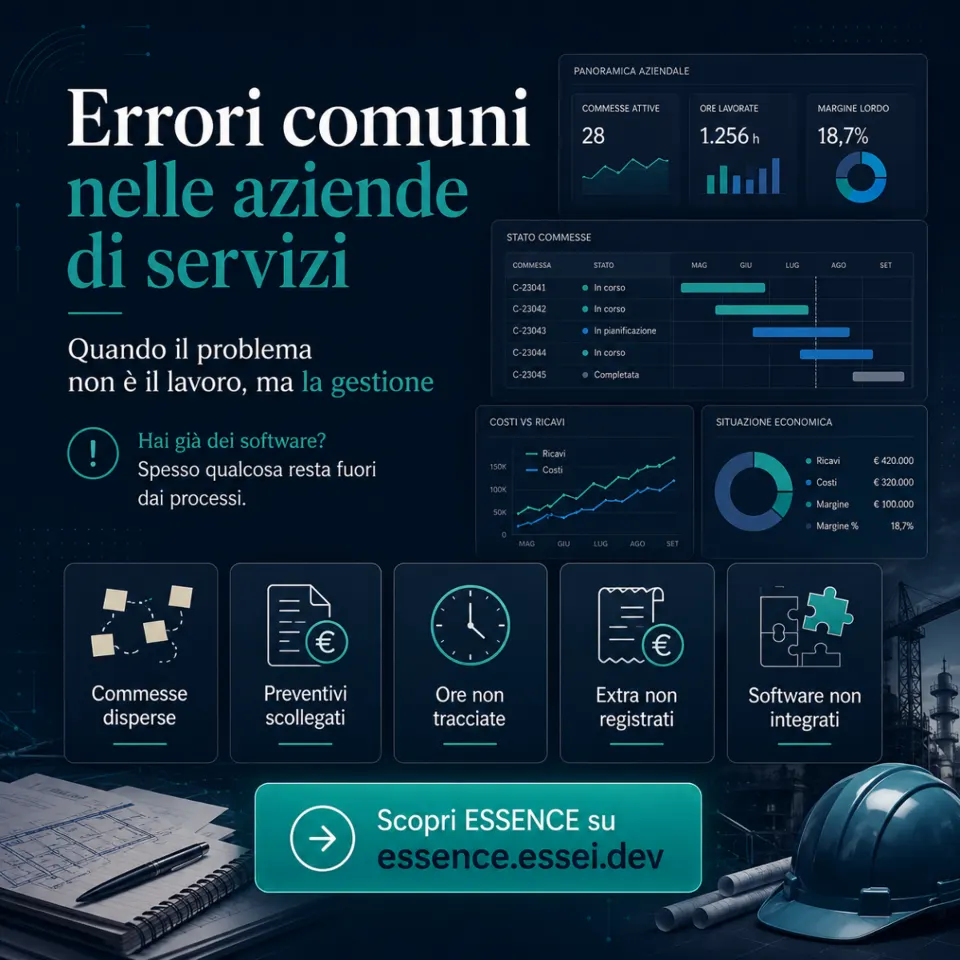
One of the most frequent mistakes is managing each job as a collection of scattered information.
The quote is in a file.
The activities are in a calendar.
The documents are in a folder.
The technicians' hours are on an Excel sheet.
The communications are in emails.
The site photos are on WhatsApp.
Supplier costs are with the accounts department.
Invoicing follows another path.
The result is that nobody has a complete, up-to-date view of the job.
This problem is particularly evident in building services and construction companies, where a single job may involve:
- site surveys;
- quotes;
- materials;
- field teams;
- suppliers;
- subcontractors;
- vehicles and equipment;
- progress reports (SAL);
- variations;
- technical documentation;
- safety;
- testing and commissioning;
- invoicing.
When these elements are not connected, the job is managed "from memory" or through constant internal requests for updates.
A management platform should instead let you open a job and immediately see everything: status, activities, costs, hours, documents, progress, issues and margin.
2. Not linking the quote, the work done and the final account
Many companies prepare very detailed quotes, but then cannot really compare them with what happens during execution.
The quote says one thing.
The site tells another story.
The final account arrives late, if it arrives at all.
This is a serious mistake, because without comparing planned and actual figures it is impossible to understand:
- whether deadlines were met;
- whether materials cost more than expected;
- whether extra work was carried out;
- whether the resources used were the right ones;
- whether the job kept the expected margin;
- whether future quotes need to be adjusted.
In service companies, every job should generate knowledge.
If a job went badly, you need to understand why.
If a job went well, you need to understand what worked.
If a client often asks for extra work, you need to measure it.
If a type of work produces little margin, you need to know.
The final account should not be a closing document.
It should be a tool for continuous improvement.
3. Not measuring internal hours correctly
In service companies, people's time is one of the main costs.
Yet it is often managed approximately.
The technician goes on site.
The job manager coordinates.
The office prepares documents.
The salesperson follows the client.
The project manager attends meetings.
The warehouse prepares materials.
Someone deals with an emergency.
All these activities have a cost.
If they are not recorded against the right job, the margin is distorted.
A job can look profitable only because not all the hours actually worked were charged to it.
This is one of the most dangerous mistakes, because it leads the company to underestimate internal costs and to quote unsustainable prices in future.
The question to ask is simple:
do we really know how many internal hours each job, client or contract has absorbed?
If the answer is no, management control is incomplete.
4. Handling extra work without tracking it
In many service sectors, especially building services, maintenance and construction, extra work is common.
The client asks for a change.
An unforeseen problem emerges during the work.
An additional call-out is needed.
A material has to be replaced.
A technician has to go back on site.
A task takes longer than planned.
The problem is not doing extra work.
The problem is not tracking it.
When extra work remains informal, the company risks not invoicing it, not including it in the final account and not assessing its impact on margin.
Small unrecorded tasks, added up over time, can turn into a significant loss.
That is why every variation should be linked to the job, approved, recorded and, where necessary, turned into an additional charge.
5. Not having real resource planning
Many companies plan their work with tools that are too simple for their operational complexity.
A shared calendar can tell you who is busy.
But it does not always tell you whether that person has the right skills, is available, is already overloaded, holds valid certifications, is close to the site, has the right vehicle, can use a certain piece of equipment or already has urgent tasks assigned.
In technical and service companies, planning is not just a matter of the calendar.
It is a matter of operational capacity.
Good management should take into account:
- resource availability;
- skills;
- roles;
- certifications;
- offices and sites;
- vehicles;
- equipment;
- priorities;
- emergencies;
- workload;
- hourly costs;
- scheduled and extraordinary activities.
Without this data, you risk overlaps, delays, inefficiencies and extra costs.
6. Losing control of documents, deadlines and obligations
In many building services, construction and maintenance companies, documentation is essential.
Technical data sheets, certifications, declarations, reports, safety documents, contracts, orders, delivery notes, photos, job sheets, permits, site documentation, certificates, deadlines for vehicles and equipment.
When these documents are scattered across folders, emails and personal archives, operational risk increases.
A missing document can slow down a job.
A forgotten deadline can cause problems.
An expired certification can prevent access to a site.
An attachment that cannot be found can create tension with the client.
Document management should not be separate from the job.
Every activity, client, installation, site, resource or vehicle should have its own documents linked, up to date and easy to consult.
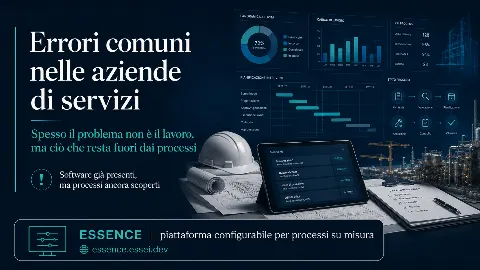
7. Having software in place, but processes still uncovered
Many companies today already use one or more management software packages.
This is normal and often positive.
A company may have software for accounting, one for invoicing, one for attendance, one for the warehouse, one for document management, one for technical call-outs or a tool specific to its sector.
So the problem is not always a lack of software.
The real problem is that not all business processes are covered.
There is almost always something left out.
It may be a procedure still handled in Excel.
A communication entrusted to WhatsApp.
An approval given by email.
A check done by hand.
A report built every month by copying data from several sources.
Extra work that never makes it into the management system.
Technician planning that does not take skills, certifications or equipment into account.
A job followed operationally with several tools, but without a single view.
In many service, building services and technical construction companies, this situation is very common.
The accounting software works.
The invoicing program works.
The warehouse system works.
The call-out calendar works.
But the link between quote, work carried out, hours worked, materials used, documents, actual costs, progress and margin is left out.
And it is precisely in these uncovered gaps that inefficiencies arise.
When a process stays outside the company's systems, three things often happen:
- data is not recorded in a structured way;
- information depends on the people who know it;
- management cannot get a complete, up-to-date view.
The result is that the company has software, but does not always have an integrated control system.
Having many tools does not necessarily mean having all processes under control.
The real question to ask is not:
"Do we already have software?"
The more useful question is:
"Which processes are still left outside our software today?"
Because the loss of efficiency often does not come from the processes that are already digitised.
It comes from those left on the margins.
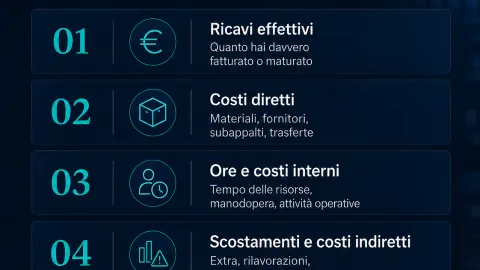
8. Not analysing margin by client, job and service
Not all clients generate the same value.
Not all jobs are really worthwhile.
Not all services are equally profitable.
A common mistake is to look only at overall turnover without analysing margin by:
- client;
- job;
- contract;
- service;
- geographical area;
- team;
- department;
- type of call-out;
- salesperson;
- supplier.
A client with high turnover can absorb many internal hours.
A recurring contract can look stable but produce a low margin.
A major job can tie up valuable resources for too long.
A service can be sold below cost without the company noticing.
Healthy growth does not depend only on the number of jobs won.
It depends on the ability to understand which jobs really produce value.
9. Waiting until the end of the month to see how the company is doing
Many business decisions are made on data that arrives too late.
The monthly report arrives when the job is already well under way.
The supplier's invoice arrives weeks later.
Hours are entered at the end of the month.
The margin is calculated when it is too late to act.
This approach limits decision-making.
Management should be able to monitor in real time:
- jobs running late;
- costs over budget;
- hours above plan;
- work not invoiced;
- overloaded resources;
- upcoming deadlines;
- the most demanding clients;
- falling margins;
- progress compared with invoicing.
Knowing what happened is useful.
Knowing what is happening is far more important.
10. Thinking that software should impose the process on the company
Every company works differently.
A building services company does not have the same needs as a consultancy.
A construction company does not manage jobs like a maintenance company.
A business with technicians in the field has different problems from one that works on internal projects.
A group with several offices has different needs from a small specialist company.
One of the most common mistakes is trying to adapt the company to rigid software.
In reality, the opposite should happen.
Software should adapt to the company's processes, build on what already works and improve what currently creates inefficiency.
That is why it is important to choose configurable platforms that can grow over time and be customised to real operational needs.
ESSENCE: a configurable platform that completes, integrates and adapts business processes
ESSENCE is the ERP platform developed by ESSE I to help service, building services, technical construction, maintenance and consulting companies, and structured organisations, manage operational processes and management control in an integrated way.
It does not assume that the company has to get rid of everything it already uses.
Many companies already have well-established software, procedures and tools.
The point is to understand what works, what can be kept, what can be integrated and what is currently left outside the company's control.
ESSENCE was created precisely for this: to offer a configurable platform that can adapt to the client's real needs and cover the processes that standard software often cannot fully manage.
It can be used to manage processes directly, such as:
- clients and CRM;
- quotes;
- jobs;
- sites;
- activities;
- field teams;
- technicians;
- timesheets;
- job sheets;
- documents;
- materials;
- suppliers;
- subcontracting;
- deadlines;
- contracts;
- maintenance;
- tickets and requests;
- costs;
- revenue;
- margins;
- management dashboards and KPIs.
Or it can be designed to sit alongside and integrate the tools already in use, becoming the link between departments, data and operational processes.
The strength of a configurable platform is not imposing the same method on everyone.
It is allowing the company to build a system consistent with the way it works.
That is why ESSENCE can be adapted to specific needs: a particular approval workflow, customised document management, advanced job control, a tailor-made dashboard, an internal technical procedure, site management, a job-sheet module, a link with existing software or a completely new function.
The goal is simple: not to leave important processes outside the company's control.
ESSE I: custom software for real needs
Every company has different processes, issues and goals.
That is why ESSE I does not just offer a product, but works alongside companies to analyse their processes and develop custom software solutions.
If a requirement is not already covered, it can be analysed, designed and developed.
Whether it is a specific module, an integration with existing systems, a custom dashboard, an approval workflow, special document management or a unique operational process, ESSE I can help the client build the most suitable solution.
Because technology should serve the company.
Not complicate it.
Conclusion
Many problems in service companies do not stem from a lack of work or skills.
They stem from the difficulty of controlling increasingly complex processes with tools that are not always connected.
Even when the company already uses management software, there are often activities, procedures, checks or information that remain outside the system.
It is precisely these uncovered processes that generate inefficiencies, errors, wasted time, incomplete data and difficulty in calculating real margin.
Digitalising does not simply mean adding another piece of software.
It means building a more orderly, measurable and controllable way of working, able to connect what is fragmented today.
ESSENCE was created for this: to help companies manage processes, jobs, resources and margins in an integrated, configurable way that fits their real operational needs.
And when a requirement is not already covered, ESSE I can analyse it, design it and develop a custom software solution.
Because every company has its own processes.
And every important process deserves to be managed the right way.
Discover ESSENCE and contact ESSE I: