When, some months ago, we relaunched the ESSE I brand, we promised ourselves that, alongside our editorial plan of news and practical tips on IT and coding, we would add new content about our life behind the scenes. Content about who we are as people and as professionals. About our team, as well as what we do.
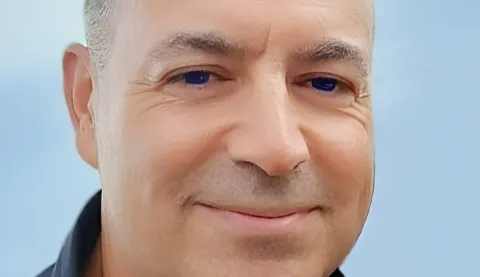
So today, after our "chat" with our CEO Massimiliano Aiello, we publish the interview that our marketing manager Leo Cascio did with senior developer Antonio Martino.
For anyone wondering what a senior developer's role is, a quick recap may help.
A senior developer is a software development expert responsible for software design, development and architecture. A professional who often has to solve complex problems and who leads the team, acting in part as a "mentor" to newcomers. And who focuses on code quality, optimising overall performance and thereby contributing to the organisation's technological growth.
In short, the senior developer is a key figure within an organisation. And our Antonio Martino is definitely a key figure at ESSE I.
Leo: Hi Antonio, and welcome to our "chat" column. I introduced you as ESSE I's senior developer. Would you like to tell us more?
Antonio: Thank you, Leo. I mainly do coding; I'm a programmer in every sense. I handle development but also the supervision of live services. With the people in my area, we look after the infrastructure, domains and hosting of all services, monitoring their activity and performance. For infrastructure, of course, we rely on leading third-party providers.
L: You mean technology partners, right? Such as?
A: Exactly. For example OVH, a leading hosting company. But we also rely on other international providers, usually based in Europe. Obviously we set up and manage services according to the clients, their needs and their budgets. Basic services for those without demanding requirements who want to spend little, but mostly we work with advanced services for those with greater needs: clustering, containerisation, redundancy, automated data backup/replication processes, monitoring, business analysis and so on. It depends on what clients want to do. They ask, and we, as consultants, advise them and give them a suitable solution.
L: But let's get back to development, since it's your main job. What languages do you use? And which relational database do you rely on for ESSE I's coding work?
A: I develop in C# (Microsoft .NET), with Visual Studio, and for databases we almost always rely on SQL Server and MongoDB. At ESSE I, as you know, we're very attached to Microsoft.
We used to use "stored procedures" directly on the database, i.e. precompiled procedures, which are still valid on old-style projects that need high performance. Now we also use Entity Framework (EF), an open source object-relational mapping framework for ADO.NET that was originally part of the .NET Framework but has been separate from .NET since version 6. Basically it's a sort of "package" that talks to the database from code, running the "queries". It works by querying the database directly from code, which makes the work much easier. This specific feature is called LINQ (Language Integrated Query), and it also works with sources other than databases. Do you know what its advantage is? It lets you use a single syntax for every data source without having to learn different query languages.
L: It seems you're something of Max's "technical right-hand man". What do you think of that? Would it be fair to say you untangle a lot of knots, saving Massimiliano and ESSE I a lot of time?
A: It's partly true, and I'm very proud of that role. Let's say I handle a certain part of the work on behalf of ESSE I. Also, together with Max and the other team members, I provide consultancy on behalf of other client and partner companies, usually taking direction directly from external managers who, in turn, manage various work and staff flows. After all, some of our clients are other software houses or companies working in marketing and communication. At other times we deal with end clients.
L: Going back to Microsoft, why Microsoft in particular?
A: I started with Microsoft by chance and then, of course, there was a natural evolution over time. My seniority has grown over the years to the point where, professionally, I couldn't do otherwise. Also, although people say a lot of negative things about Microsoft (bashing Microsoft often seems like a sport), the products and tools for us professionals are on a completely different level from the average. And, to be honest, with my background I think I hold my own.
L: Because Microsoft has a certain authority…
A: Yes, as well as authority it has experience, broad shoulders. Other software and platforms have it too, but in my view Microsoft is a step ahead. I know it sounds like I'm advertising, but I'm the most pro-Microsoft person at ESSE I.
L: You know, many years ago, when I was a web developer, I programmed in PHP too, but without complex development environments. Notepad was enough for me…
A: In theory you can use Notepad with C# and every other language too. But productivity would collapse so drastically that you could no longer compete on the market. And once you're used to tools that help you write, clean up and debug (which is essential for us developers), going back to Notepad would turn your hair grey. Besides, I still consider Visual Studio the best development tool around.
L: A clear professional point of view, and one I fully share.
By now you know me a bit, Antonio, and you know I'm as curious as a monkey. So I'll try: would you like to tell us about a project you're developing at ESSE I right now that you, as senior developer, are following on the front line?
A: Of the many projects I'm working on, at the moment my main focus is a big project in the tailoring sector: a platform where, let's say, customers can order made-to-measure clothes online. A platform that also includes apps which scan your body and work out your measurements. Something really cool. In practice, as well as being a management system, it's a platform that connects garment makers, big brands and end consumers. All integrated, of course, with the companies' e-commerce front ends.
L: A little bird told me about it, and I can't wait to write about it on the blog one day, you know? Which, for obvious reasons, isn't possible right now.
A: I can guess who the little bird is! :) Besides these projects, I can't let go of supervising our own website. Although often, swamped with work, I can't approve the requested changes and everything stays on hold. What's the saying? The cobbler's…
L: …children have no shoes. Understandable when the company is very busy with clients.
But let's change the subject. Since it's all anyone talks about these days, I want to ask you: in your view, where is the coding world heading? What do you think of the latest developments in AI, now also used for programming?
A: I think AI should be welcomed in this field too. But I don't think it will be able to do everything: it will only be able to write pieces of code; it will never create quality software from scratch. Going back to what I said about ESSE I "translating clients' requests into code", I strongly doubt AI can do that. AI is a valuable helping hand that speeds up the work, but it doesn't replace the programmer. And I don't think it ever will. Sure, it may cost some people their jobs in this sector too, but a good programmer will never lose their job because of AI.
L: I couldn't agree more. What you say is very similar to what I say – in my own field – about content creation.
Antonio, to close I want to focus on you, because, as I said at the beginning, we promised to let people get to know us as people too. As "ESSE I's first employee", would you tell us about the beginnings of your career as a developer and how you met Max and joined the company?
A: I started programming in 1998 after a vocational course that included a module on web development. Right from the start I loved being able to build websites by myself. I saw it as a way to turn my ideas into reality. From there I started putting it into practice while I kept studying programming. I remember that back then I built dynamic websites with ASP…
L: Tell me about it. Before I moved into marketing, I too built sites with Active Server Pages connected – horror! – directly to Access databases!
A: Back then it was "normal". Later, once trained, I got a job at a small local agency, and for many years, until 2015, I worked there as a web developer. During that time I helped my former boss grow his company. It was he who, after a few years, recommended me to Massimiliano, who offered me the chance to join ESSE I Solutions, now ESSE I. And here I am.
L: And it seems you hit it off straight away. I'd say there's never been a better choice, given where you've got to!
A: Yes. He trusted me from the start and I trusted him. Today I have enormous trust in ESSE I, and in Max. He's a very understanding and patient person; to me he's like a brother as well as the CEO.
L: I too appreciated his humanity straight away (genuine, not fake, unlike so much "brand washing"), an attitude that creates and maintains harmony in the company (our payoff "harmony, not just bits" comes precisely from this). I know what you mean, and once again I can only agree with you.
Just one last question, Antonio: where do you see yourself professionally in ten years?
A: In ten years? I hope to still be working at ESSE I in the technical area, of course, but with even more responsibility than now – which I'm actually already starting to have – guiding the new people who are gradually joining the ESSE I family.
L: So you'll get your hands "dirty" with coding less, and talk to and coordinate the team more?
A: Yes, but I'll keep getting my hands dirty! I think that to be a good IT manager I'll still have to get my hands dirty. Mine is a role where you have to know how to do things.
L: I couldn't agree more, Antonio. Thanks for a great chat, all the best with your work, and see you next time!