In the digital age we live in, a solid online presence is now essential for almost every business. And when it comes to "online presence", you can't avoid talking about the website.
One of the crucial decisions to make when preparing to build one – or to entrust a professional, a web agency or an ICT company to do it for us (incidentally, website development is one of ESSE I's core businesses) – is whether to develop it from scratch or with the help of a CMS, a Content Management System.
There are a great many CMSs, and many of them are free and open source. Essentially, you just download them and install them on your preferred hosting to use them with minimal IT skills. Others come already installed, so they are even easier to use (usually for a monthly or annual fee).
"With a CMS" and "from scratch" are therefore the two main roads to take when building a website. Both have advantages and disadvantages, and the choice can depend on several factors.
In this article we will look at the pros and cons of each option to help you make the best choice.
Of course, given how simple the topics covered are, this article is not aimed at experienced programmers, but at beginners and above all at business owners (perhaps tech-savvy ones who already "play" with CMSs and are wondering whether to use them professionally too) who want to gain the awareness needed to optimise their investments and achieve their business goals.
Let's start with the simplest, cheapest option: using a CMS.
CMS
Among the most popular, we would mention five:
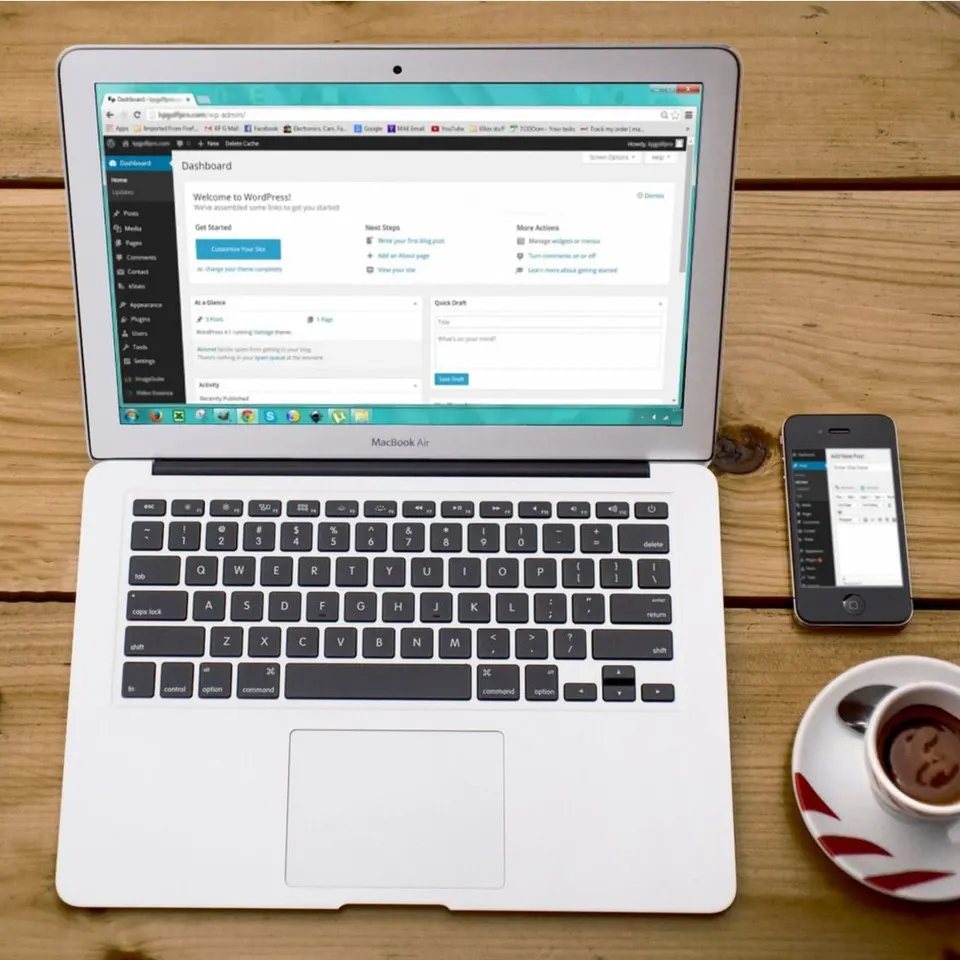
- WordPress: probably the most widespread CMS, widely used to create blogs, company websites, news sites and much more. It has a vast range of themes and plugins that allow quick and easy customisation. It is known for its ease of use and has a large community of developers and users offering support and resources.
- Joomla: a versatile CMS often chosen to build more complex websites, including e-commerce, news portals and social networking sites. It offers a modular structure and lets you manage different types of content effectively. It is appreciated for its flexibility and offers a range of extensions to add specific features.
- Drupal: a powerful CMS – no, not exactly a toy for tech-savvy business owners! – used to build more complex, high-end websites such as those of large companies, government institutions and online communities. It is highly customisable and offers a high degree of control over features and design. Drupal is valued for its flexibility and scalability, but has a steeper learning curve than other CMSs.
- Magento: an e-commerce platform offering advanced features for building online shops. It is ideal for companies that want to manage large product inventories, offer various payment options and create a personalised shopping experience. Magento is highly flexible and customisable, but may require more advanced technical skills.
- Shopify: a cloud-based e-commerce platform that simplifies creating and managing online shops. It is ideal for small and medium-sized businesses and offers a wide range of themes, apps and sales management tools. Shopify is known for its ease of use and because it requires fewer technical skills than other e-commerce solutions. Unlike the first four CMSs listed, which are open source, it is based on proprietary software.
Advantages of a CMS
In our view, the main advantages of using online software to create a website without typing a single line of code (see the first point) are three:
- Ease of use: CMSs generally offer an intuitive web interface that lets anyone, even without in-depth technical skills, create and manage a site. Yes, sadly, even your cousin!
- Time savings: with a CMS you can use predefined templates and plugins to add features without writing code from scratch. This can mean considerable time savings.
- Community support: CMSs have active communities of developers, designers and users ready to help you. This can be invaluable if you run into problems or have questions.
In short, using a CMS greatly reduces the time and cost of developing a website. All good, then? Not quite. Read on to find out why.
Disadvantages of a CMS
If we think about the real reason for building a website, we realise it is usually built for promotional purposes, to make our company, products or services better known. In short, our need simply comes from the fact that we want it to help us… sell!
This awareness – which, in truth, not everyone who builds a site has – obliges the decision-makers involved to adopt a business-oriented mindset, one that recognises the central role of marketing. In other words, a mindset that considers the importance of using the website to communicate your uniqueness, offering an experience that is as personalised and customer-oriented as possible.
Why is uniqueness important? To stand out from competitors.
The risk, in fact, is that people see us all as the same and end up choosing the lowest price.
Remember the price war? That is exactly the situation no business owner should ever find themselves in, unless they can afford it, because they would not earn enough to sustain themselves.
Failing to focus on uniqueness is usually both a cause and an effect for those who opt for a CMS to save money. And so they end up battling with software which, short of extensive and costly work, usually does not allow you to create unique or sufficiently customised websites.
In short, although a CMS is a good compromise when ambitions are non-existent or limited, it rarely serves the cause of business.
So, to sum up, the main disadvantages of a CMS are:
- Customisation limits: while CMSs offer some flexibility, you may have to make big compromises on a particular design or features you have in mind.
- Standardised performance: it's not just about customisation! CMS-based websites often share a similar structure and code, which can affect performance, especially if not properly optimised. In other words: a slow site, or one that shows errors, is not a good calling card.
- Vendor dependence: if the CMS you are using stops being developed or no longer meets your needs, you may face a complex migration to another platform.
A website from scratch
Now let's turn to the opposite solution: building a site from scratch.
There are many web coding environments but in this case, unlike CMSs, we'll spare you the lists. Just remember that websites are web applications in every sense, which means they can be developed in sophisticated environments designed for the purpose. At ESSE I, for example, we use a mix of tools whose "heart" is undoubtedly Microsoft Visual Studio.
Let's look at the advantages straight away. For us there are three main ones:
- Complete control: you have total control over every aspect of design, features and performance. You can create a website exactly as you want it, without the limitations imposed by a ready-made CMS. In theory, if you have the financial, human and professional resources, you could build your own Amazon and make big money.
- Advanced customisation: as we said when talking about uniqueness, if you have particular needs or a unique design in mind, building from scratch lets you create highly customised solutions without having to adapt to a CMS's restrictions. So you can set yourself apart from competitors, to the benefit of your brand and business.
- Performance optimisation: you can optimise every line of code for better performance, reducing load times and improving the overall user experience. Many studies confirm that the faster, easier and more pleasant a site is to browse, the more time visitors spend on it, increasing the chances of turning them into customers.
All good, then? Here too we have to answer: "Unfortunately not!"
Like CMSs, this approach has disadvantages too. We have identified two main ones:
- Time and cost: development from scratch requires more time and financial resources. You will have to create everything, from basic features to the user interface, which can be costly in terms of time and money. Sad but true: if you don't have the budget and resources, it's not a viable route. And goodbye, new Amazon…
- Complexity: building a website from scratch requires advanced technical knowledge. If you are not an experienced programmer, you may find this route impossible. For those doing the work, this means having significant skills; for those delegating, it means the burden of finding suitable people who can do the job well, which is far from a given. We hate to boast but, modestly, we are equipped for this. Don't believe us? Of the many websites we have built, we invite you to visit those of Caffo Store, of the Associazione Nazionale Sindacale Attività Produttive, of Bufala Punto Eat, of Cubitude (a project for the University of Calabria that we wrote about here), of ecoESSE and of our own project ESSE24.
In conclusion...
The choice between developing a website from scratch and using a CMS depends on your specific needs, your technical skills and your budget. If you have the time, resources and skills to build from scratch, you can get a highly customised, high-performing site. On the other hand, if you want a quicker, cheaper and more user-friendly solution, and your sales goals are modest, a CMS could be the right choice. Download WordPress, upload it, install it, configure a database to connect it to and… have fun!
Remember, though, that whatever you choose, it is important to plan your project carefully, assess your needs and consider the long-term implications. Whether you decide to build from scratch or use a CMS, your ultimate goal should be a website that fits your needs perfectly and offers users an engaging experience. In practice, choosing a CMS-built site does not exempt you from devoting resources and time to it.
In all this, having a business vision – better still, a marketing one – helps enormously. Indeed, we would add that it is crucial.
At ESSE I we are ready to help you whether you choose to build a website with a CMS (incidentally, we have built one ourselves – we named it "CMESSE" – which we can configure and customise to your needs without making you sell a kidney!) or whether you take the certainly more expensive route of developing your new site from scratch.
A steep road which, once you reach the top, will become downhill, and could give you a significant chance of success.