For some years now there has been a lot of talk in companies about gamification, a design strategy that applies elements, dynamics and mechanics typical of games to non-game contexts such as education, work or marketing. This approach has been very successful thanks to its main goal: engaging and motivating people, encouraging them to take part more actively in the proposed activities.
Play is, after all, one of the most enjoyable human activities. We play as children and keep doing so as adults because, essentially, it gives us pleasure and we don't want to give it up.
Thanks to gamification, even boring or tiring tasks become less unpleasant.
Think, for example, of filling in questionnaires, often replaced by quizzes complete with a "presenter avatar", to which the gratification of a prize can be added: an incentive that encourages people to take part in order to reach the game's goals. The gratification need not be material; it can also be a compliment or a thank-you for completing everything.
This mechanism motivates the player, often prompting them to repeat the action to even higher standards and restarting the virtuous circle of gamification.
Among the elements involved in a "gamified" activity we can list:
- Points: numerical points are awarded to users for completed actions, such as answering questions or reaching specific goals;
- Badges: awarded to participants to recognise their results or the levels of competence they have reached;
- Levels and progression: a learning or engagement path can be structured with levels or stages to reach, each step representing an increase in difficulty or competence;
- Rankings and leaderboards: lists ordered by points can be drawn up to stimulate competition between participants and engage the community;
- Rewards and prizes: discounts, access to exclusive content or special opportunities can be offered to encourage completion of activities, or even a simple but satisfying "congratulations, you've won!";
- Challenges and missions: these can be structured as narrative adventures to make the experience more engaging;
- Immediate feedback: speed of response is another way of providing motivation in the learning or participation process.
As we said, one of the fields that has made most use of gamification is education, which has helped turn the saying "learning through play" into reality. Quite a few training courses, both private and public, have replaced cold assessment tests with quizzes that let you track your progress. And some have taken gamification further, using this approach in developing applications that can be considered real video games. Think of the many corporate games now on the app stores, not to mention game-like applications that use AR and VR devices in virtual 3D environments.
Gamification can also be used not only where there is a predefined path to follow or where questions have right or wrong answers, but also in exploratory environments where the concept of right and wrong does not exist. Specifically, we mean replacing psychological or behavioural assessment tests.
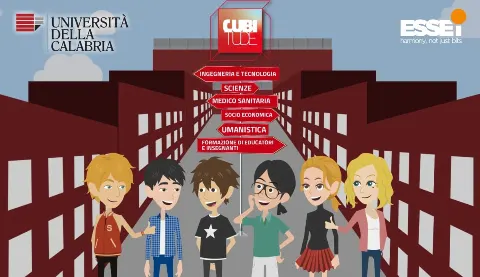
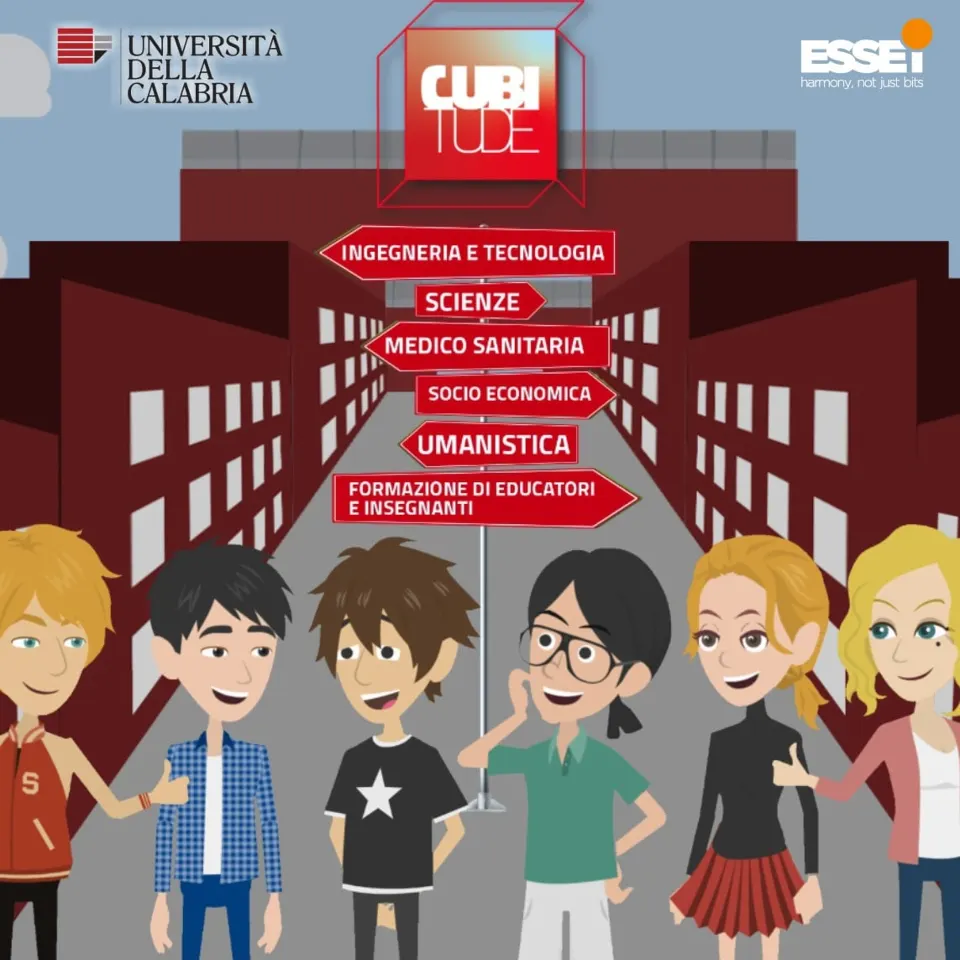
This is precisely the kind of gamification behind a project we at ESSE I built at the invitation of the University of Calabria, called "Cubitude", which we want to talk about because we consider it important both for students' path towards self-awareness of their aptitudes and for universities that might adopt a solution of this kind.
What is Cubitude
Given how important guidance is in adolescence – in terms of self-knowledge, understanding one's inclinations and building one's future – and at a time marked by new forms of communication favoured by students themselves, a game of the edutainment kind (education and entertainment) was developed with the collaboration of accredited psychologists and under the supervision of Professor Angela Costabile, developmental and educational psychologist and the University of Calabria's guidance coordinator.
Students (the protagonists of the game) set out on a "virtual" journey, interacting with their travel companions and managing unexpected events and decisions together with them in situations that simulate real contexts.
Hence the name Cubitude, which combines the words "cube" (because the University campus is a very large area whose buildings – housing departments, classrooms, laboratories, offices and so on – are shaped like cubes) and "attitude".
In Cubitude, every decision each student makes during the simulation is assessed on the basis of a series of transferable cognitive, managerial and relational skills.
At the end of the game (which lasts 30-40 minutes at most), students see their own report containing:
- their affinity with the six different areas of the University of Calabria's academic offering;
- a short profile of their personality;
- their main strengths.
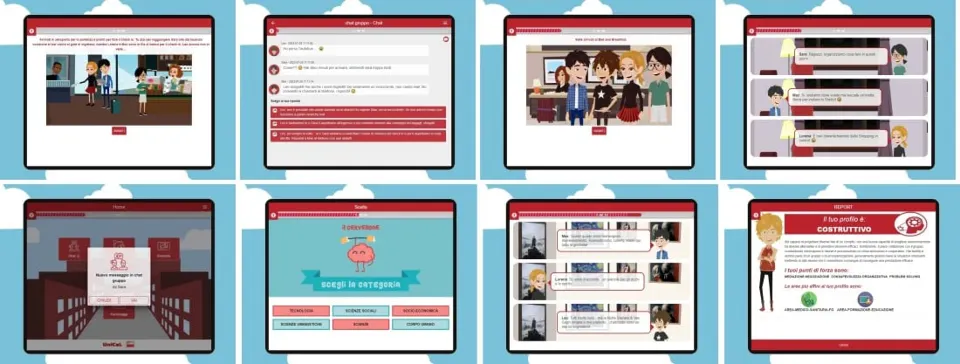
Naturally, the game ends with a section for discovering the University of Calabria's various departments, so that students can consider enrolling, with their potential highlighted to minimise the risk of choosing a degree course far removed from their profile.
Running Cubitude requires the involvement of a teacher (usually a guidance coordinator) who, in collaboration with the university's Guidance, Inclusion and Career Service area, activates the various phases of the guidance process (student registration and simulation debriefing).
We were pleased to present this project of ours, to which we devoted time and resources, including in developing its back-office platform.
From the game sessions held, the university can obtain extremely valuable data that can contribute to more informed planning of its academic offering, while schools can obtain aggregated data to understand, through specific metrics and year by year, how their teaching is evolving from a different point of view – all while fully preserving each student's privacy.
Now we'd like to ask you: what do you think of gamification?
And, above all, are you a company interested in applying gamification to software development, or a university decision-maker interested in the solution?
Would you take a look at the Cubitude project?
You can find it at cubitude.unical.it.
And if you want to know more, contact us using this form. Your feedback is always important to us!