The figure of the IT consultant has its roots in the history of computer science, an interdisciplinary science which, as everyone now knows, deals with processing information and automating processes.
Among its "pioneers" – very poetically, for us, "the first IT consultants" – we want to list seven:
- Charles Babbage (1791-1871), considered the father of computing thanks to his invention of the mechanical "Analytical Engine".
- Alan Turing (1912-1954), who helped define the fundamental concepts of theoretical computer science.
- John von Neumann (1903-1957), mathematician and physicist who contributed to the design of modern computer architecture.
- Grace Hopper (1906-1992), who played a key role in developing the first programming languages such as COBOL.
- John Presper Eckert (1919-1995) and John Mauchly (1907-1980), builders of ENIAC, one of the first electronic digital computers.
- Claude Shannon (1916-2001), considered the "father of information theory", essential to the design of digital circuits.
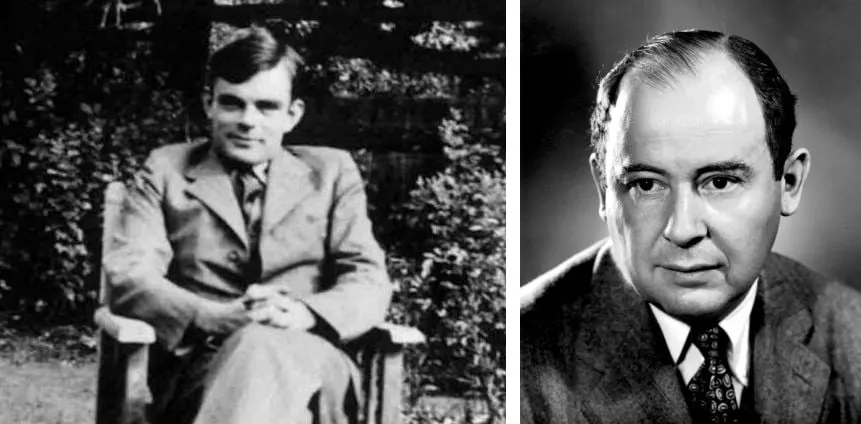
Left, Alan Turing. Right, John von Neumann (photos: Wikipedia)
We believe it was above all these people, through a scientific approach and brilliant intuitions, who made computing a fundamental science in the history of modern humanity. Without computing – and therefore without computers and all the devices that embed their logic – the very concept of modernity would probably make no sense.
But computing was also shaped by many other brilliant minds during the second half of the 20th century, and grew as a discipline thanks to the contributions of scientists, engineers, mathematicians and entrepreneurs from all over the world.
In the 1960s and 1970s, on the professional front, the spread of computers in companies and organisations created a growing need for specialist consultancy to implement and manage computer systems. This was the era when the first IT consulting firms, such as IBM and Accenture, began providing these services to businesses.
In recent decades, on the other hand, on the personal front (but in fact on the professional one too, taking significant market share from IBM), computing has made its way into homes around the world, not only through the invention and spread of the internet, but thanks to the contribution of entrepreneurs such as Bill Gates, founder of Microsoft, Steve Jobs, father of Apple, and Larry Page and Sergey Brin, the inventors of Google.
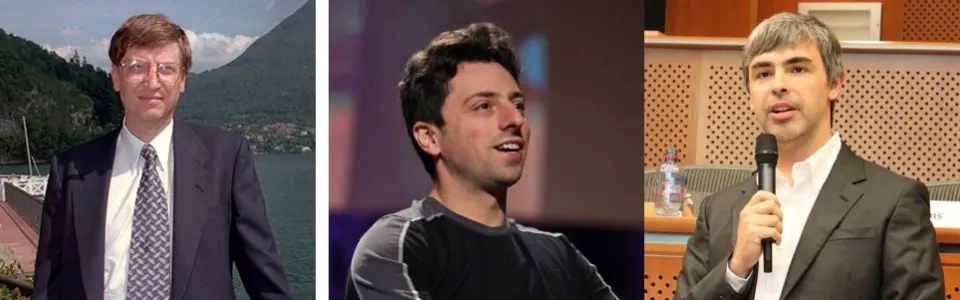
Left, Bill Gates in 1995. Right, Sergey Brin in 2010 and Larry Page in 2009 (photos: Wikipedia)
Perhaps, less poetically, we could consider them, along with the IBM people, the first and most important IT consultants in history, who inspired a multitude of IT consultants large and small.
Like our Max, for example, who became passionate about computers in the 1980s, the boom years of home computing, laying the foundations to later become a fully-fledged IT consultant.
The IT consultant today
But, back to the present: what does an IT consultant do? What is their role? And how will it evolve in the future, given the historical period we are living through, in which AI – according to many – even seems to threaten it?
Technically, an IT consultant is a professional who specialises in providing advice and support on information technology (IT) and computing. Their main responsibility is to help organisations and clients make informed, strategic decisions about using and managing information technology to achieve business or personal goals.
The activities they generally carry out are:
- Needs analysis: understanding the needs and goals of the organisation or client to determine how information technology can be used most effectively to meet them.
- Solution design: creating technology plans and strategies to develop, implement or improve IT systems, infrastructure and processes.
- Implementation and management: working with stakeholders to implement the identified technology solutions, ensuring proper integration and smooth operation of the systems.
- Troubleshooting: providing technical support and solving problems that may arise while using the systems.
- Security: helping to ensure the security of information and data by developing security policies and implementing protective measures.
- Training: providing training and instruction to staff or clients on using and managing the systems.
- Monitoring and optimisation: tracking the performance of systems and IT technologies and making improvements or updates where necessary.
- Strategy: offering strategic advice for the continuous evolution of IT in line with long-term business goals.
IT consultants are therefore qualified professionals with extensive knowledge of computing and information technology. They may work independently as freelancers or be employed by specialist IT consulting firms. They are not salespeople; they let the people in front of them choose the services best suited to their needs. At ESSE I, for example, we mainly rely on in-house staff for this. In fact we don't sell, preferring our clients to buy calmly and with complete freedom.
But what are the fields in which an IT consultant can work?
It is impossible to list them all: computing is now such a vast science that a selection is unavoidable.
We would still like to point out the IT consultants most in demand on the market today:
- Cybersecurity consultant: specialises in protecting computer systems, data and networks from cyber threats such as hackers, malware and security breaches, carrying out activities such as penetration testing, risk assessment and security policy development.
- Infrastructure and network consultant: focuses on designing and implementing network infrastructure and communication systems, including servers, routers, switches and advanced networking technologies.
- Software development consultant: an expert in designing and developing software tailored to clients' specific needs. They may work on web or mobile applications or embedded software.
- IT project management consultant: helps organisations plan, coordinate and carry out complex IT projects, focusing on managing time, resources and budget.
- Business intelligence and data analysis consultant: collects, analyses and interprets business data to help organisations make informed decisions. They may develop dashboards, reports and predictive models.
- Cloud computing consultant: with the growing adoption of the cloud, helps organisations migrate to, implement and manage cloud-based solutions. At ESSE I, for example, we do this with Microsoft Azure, without neglecting Amazon Web Services (AWS) and Google Cloud Platform.
- IT management consultant: focuses on the efficient management of IT resources and processes within organisations, ensuring that information technology supports business goals.
- Web development and management consultant: designs, develops and maintains websites. They may also handle search engine optimisation (SEO) and digital marketing.
- Artificial intelligence (AI) and machine learning (ML) consultant: an emerging role able to develop machine learning models, artificial intelligence applications and implementation strategies.
- IT support consultant: provides technical support to end users, solves hardware and software problems and manages the maintenance of computer systems.
IT consultancy in the future
As well as the ten consultants listed, there are other roles linked to emerging technologies. As computing keeps evolving, some consultants specialise in innovative fields such as the Internet of Things (IoT), blockchain, augmented reality (AR) and virtual reality (VR).
We are talking about a whole range of new and potentially "disruptive" technologies, able to drastically change the way IT consultants (and other professionals too) will work and relate to the colleagues, partners and clients of the organisation they work for.
In general, business needs will become ever more complex, and so the skills required will have to keep up. The IT consultants of the future will have to adapt to these challenges, acquire ever more specialised skills and play a strategic role in guiding organisations to success in the digital age.
At ESSE I we believe that being well prepared will not be enough: soft skills will also play an important role in winning the growing competition, including that with AI. Which is only competition if we fail to make the most of what AI can never emulate: human sensitivity. This is one of the reasons that led us to focus not only on specialist technical training but also on humanisation, on a careful, human relationship with our stakeholders, always bearing in mind and applying the value of harmony in our daily work.
No one knows how the future of IT consultancy will unfold. Thanks to our article we hope it is clear how it was born and how it has evolved to the present day, but tomorrow may be a whole different story.
What do you think?
How do you imagine the IT consultant of the future?
Tell us with a message or comment on this article on our social channels.