After a 2023 marked by the "popularisation" of artificial intelligence (Max Aiello, CEO of ESSE I, touched on this idea in the latest episode of our podcast), 2024 could see the consecration of several technologies: not only the much-discussed AI, but also other innovations that have gained momentum in recent years. "Exponential" technologies, whose rate of evolution, when plotted, does not follow a straight line but a curve. An exponential curve, in fact.
Curious and fascinated by innovation as always, we decided to dedicate the first article of the new year to this topic, also launching a poll: "Which IT technology will most influence the world of work in 2024?"
We hope you will take part (voting takes one click, you'll find it on our LinkedIn page) and, even better, share your opinion. We are talking about something that, precisely because of the exponential nature of these technologies, can have a decisive impact on society. Perhaps much more than most people, probably not very aware of these dynamics, usually expect.
1) Artificial intelligence and machine learning
As we said, AI and ML have dominated technology conversations in recent years. Very little at first, when in the second half of 2020 OpenAI launched the famous ChatGPT, but more and more over time, especially in 2023, marked by a genuine "race" among competitors to launch similar generative AI tools. The consequences? A considerable impact on the world of work (think of the many layoffs in journalism) and a constantly lively debate on AI.
In 2024 we therefore expect not only that people will keep talking about it, but also that these technologies will grow even further, reaching new levels of maturity.
We believe that advanced neural networks, the basis of machine learning, will continue to evolve.
But what are neural networks? A quick refresher: they are a subset of machine learning representing the structure and logic behind deep learning algorithms. Their name and structure are inspired by the human brain, as they imitate the way biological neurons send signals to each other.
What is striking is their astonishing progress, linked both to self-learning itself and to the evolution of chips (also exponential, according to Moore's law), which today can process many more data per second than just a few months ago. Processors that, moreover, are starting to integrate artificial intelligence features natively (we also talked about this on our social channels regarding Intel's newly launched CPUs).
In short, thanks to these innovations, AI and ML will certainly be even more at the centre of debate in 2024. But beyond that, they will be used more and more in many sectors, not only creative ones: for example in healthcare, industrial automation and self-driving vehicles.
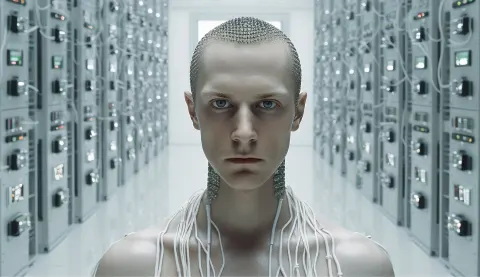
Do you know what we think? At this rate the next Time cover, famously dedicated to flesh-and-blood people, could portray AI and ML. As if to underline their "humanisation".
And here we want to spark a complex and difficult debate stemming from a fact that, at least according to researcher Daniel Miessler, is now established: the advent of "artificial general intelligence" (AGI), an AI fully able to replace us, is expected as early as 2025 (with an estimated 60% probability, rising to as much as 90% by 2028).
Which, on reflection, would seem to make 2024 a "transition phase" for AI and ML. A period that comes before the one in which these technologies, at least in theory, will be so powerful as to generate, in a not-so-distant future, an AI capable of replacing us in all (or almost all) areas of work.
So we ask ourselves, far from provocatively: will they mark the end of the very concept of "human work"? Or even, as suggested by Geoffrey Hinton, the "godfather of AI" who, together with Bill Gates and other representatives of well-known tech companies, signed the "Statement on AI Risk", will they bring humanity closer to a possible "mass extinction"?
2) Blockchain and cryptocurrencies
Not just artificial intelligence: 2024 could also be the year blockchain comes of age, both for social and technological reasons and because of its best-known application: the cryptocurrency Bitcoin.
After the cryptocurrency boom of a few years ago, which actually turned out to be more of a speculative bubble, these technologies finally seem to be taking hold with applications that are less hyped by marketing and more substantial, solid and serious.
Meanwhile, as we said, Bitcoin could enter a positive phase, growing but avoiding spikes in value thanks to two events that will happen in 2024.
The first is that Bitcoin will soon become an ETF (Exchange Traded Fund), an investment fund recognised by the SEC. This should finally give the currency prestige and perhaps clean up the less-than-idyllic reputation this crypto has had so far (not through any fault of its own, but because it has unfortunately been used as a speculative investment tool).
The second event, expected in April 2024, is the next Bitcoin "halving", when the reward for "miners" will be halved, probably also increasing its value.
Note: if we talk about Bitcoin's possible consecration, we obviously do not do so as fans (neither of this crypto nor of others, especially those which, as recent history shows, have been the subject of scams) but because we rely on historical and technical data: Bitcoin is not new (in fact, it has just turned 15) and above all it is a decentralised, open source project with the "socially noble" aim of creating an alternative currency to fiat money. A currency which, precisely thanks to its periodic halvings, has inflation tending towards zero.
Besides Bitcoin, we would like to highlight the slow but gradual rise of applications that have recently started using blockchain in other (again non-speculative) areas such as cyber security, supply chain management and traceability.
Let's not forget that blockchain works through a distributed ledger that removes the need for central intermediaries. Even if the time is probably not yet ripe to consider it a "disruptive" technology, this can still revolutionise sectors such as finance and supply chain management by removing dependence on central entities.
In security, moreover, its immutable structure makes data transparent, with positive effects on sectors such as health data management, food traceability and certification. Not to mention the possibility of using it for smart contracts: "smart" contracts that need no intermediaries and simplify the management of agreements.
3) Edge and cloud computing
Finally, we must point out that 2024 could see further growth of technologies that only appear to be opposites: edge computing and cloud computing.
Let's look at them briefly.
- Edge computing is an information processing model that differs from the traditional centralised paradigm, in which data is sent to a data centre. Here, data is processed close to where it is generated or collected, that is, "at the edge" of the network. It is particularly useful where a fast response is crucial, such as in IoT applications, autonomous vehicles and augmented reality. It also saves bandwidth, because it reduces the need to send large amounts of data over the network, sending only the relevant results to data centres or the cloud.
- Cloud computing is a model for delivering IT services that provides access over the internet to resources such as servers, storage, databases, networks, software and analytics. Instead of physically owning and managing these resources, companies can use cloud services from providers, in a centralised way, increasing efficiency and cutting costs.
In essence, with the growing number of connected devices and the expansion of IoT (some studies speak of at least 50 billion devices connected to the network by 2030), edge computing is becoming increasingly crucial: without its applications, central servers and the network itself would be overloaded. In 2024 we therefore expect this technology to come of age, offering, in certain situations and applications, more efficient solutions for processing data locally rather than sending it to remote servers.
However, 2024 could also give a further boost to cloud computing, wherever centralisation is an economic as well as a logistical advantage. Cloud computing means elasticity and scalability, allowing companies to adapt quickly to changes in workload, especially with large amounts of data that do not require heavy processing. Not to mention access from anywhere with a connection, which makes cloud services ideal for global applications. It is no coincidence that cloud computing is used by a wide range of applications such as data storage and streaming services.
In conclusion
What is increasingly emerging, and will continue to do so in 2024, is that these technologies, although conceptually opposed, can (indeed, in our view, must!) work together. The reason behind this observation, which perhaps answers the question in the title with "none in particular", is that probably value for users and companies never comes from a single technology but from their combination, that is, from the ability of those who handle them to "dose" them in the most appropriate, effective way for the context.
A "holistic" concept that obviously applies not only to edge and cloud computing but to all technologies, including those we have not discussed for reasons of space. We are thinking, for example, of 5G (which is already evolving into 6G, expected in 2025, which will give further impetus to innovation, making applications possible that are impossible today), augmented and virtual reality (AR and VR) and, last but not least, quantum computing which, although still in development, is attracting more and more attention.
To get an even better idea of what awaits us in the near future, think for example of when the first quantum computers, far faster than today's, will "run" artificial intelligence applications. An exciting scenario, but with many unknowns given the surprises (not all of them pleasant?) it could hold for us.
It is no coincidence that we want to close this article by recalling the growing importance of sustainability in the technology landscape, with a green footprint that it will be increasingly crucial to support, and the theme of awareness, which is very close to our hearts and often leads us to address these topics on our blog.
It remains to be seen how these technologies will develop during 2024 and how they will shape the future of our digital world.
For now all we can do is stay up to date and, above all, alert. And, as always, we at ESSE I are here to help you implement the latest IT technologies wisely and harmoniously in your next digital project.
For a free consultation to understand how we can put these tools at the service of your company in 2024 too, contact us here.