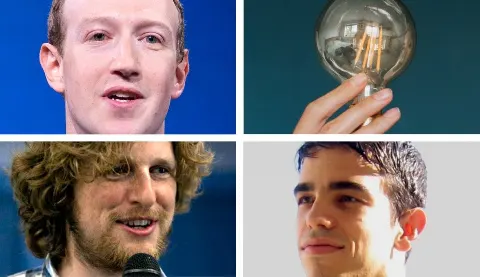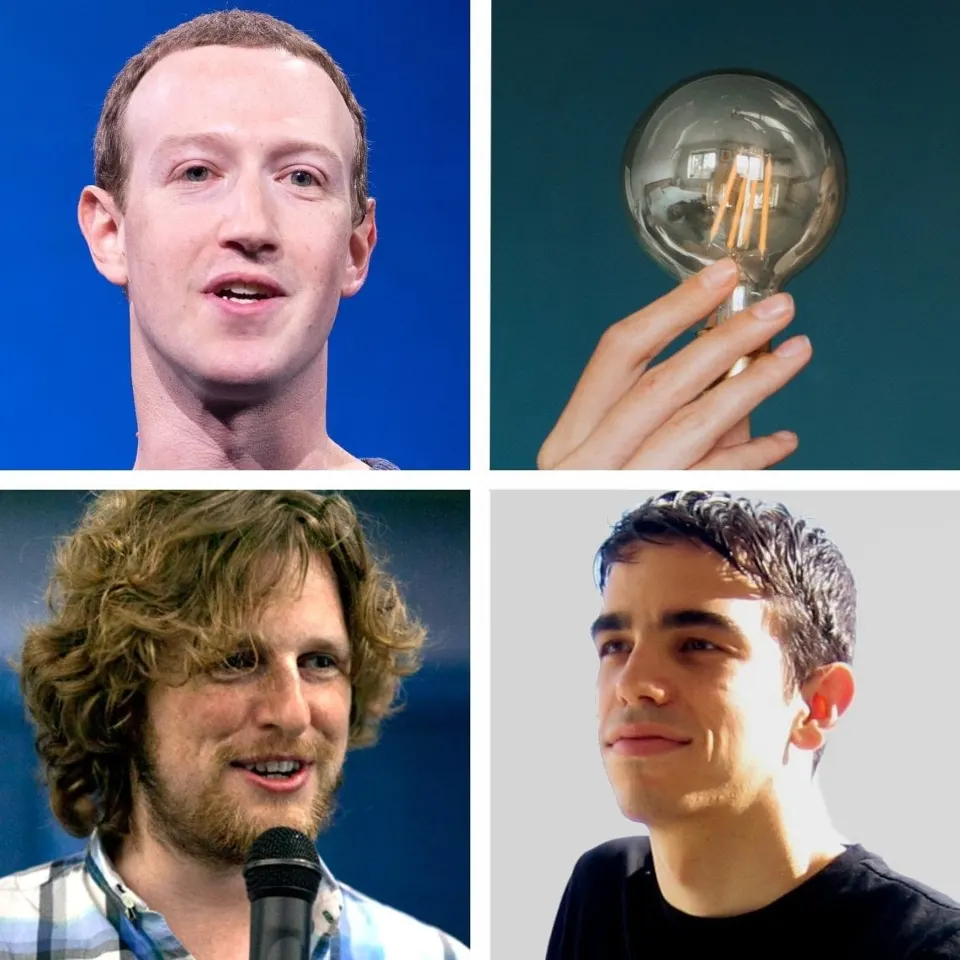
Today we are going to talk about programmers. Today we want to remember that, for a piece of software or a website to achieve the success it deserves, technical skills, however important, are not everything. What also counts is the programmer's personal vision, the ability to seize the opportunities that arise, the "mindset". As the experts say, the entrepreneurial attitude.
To be honest, managerial hard skills and personal soft skills may even be the most important ingredients of any success in digital. What we mean is that there are probably thousands of technically excellent online projects that never succeeded precisely because their marketing was missing or ineffective.
But in this article we will not talk about marketing, a topic outside the scope of our blog (which focuses more on software technology). Instead we will tell the story of three programmers (actually four, but to be on the safe side we will say three) who, starting from scratch, with a simple computer and very little money, managed to lay the foundations for building very successful projects and businesses, launching new start-ups which, growing into sizeable companies or contributing to projects already under way, in some cases even changed the world. And we will do it from our technical, IT point of view, something that, we have noticed, is often neglected in similar stories.
Some of the names you will read are very well known, others less so. Either way we think it is worth talking about them, in the hope that their stories will inspire your next digital project.
1) Mark Zuckerberg
We all know him: he is the founder of Facebook, today one of the most influential social networks. His incredible story, also told in a famous film (The Social Network), began when he was a student at Harvard University in 2004. Zuckerberg, whose brilliant idea came from responding to students' need to get to know each other and connect via the internet, started developing "TheFacebook" on a laptop in his dorm room.
But let's look at the technical side of his rise.
What did Zuckerberg use to develop Facebook? The answer is almost banal: PHP connected to a MySQL database.
He probably chose PHP because of how simply and quickly this programming language lets you build web applications; MySQL, for its part, has the advantage of being reliable and relatively easy to use.
As for hosting, not having much money, at first Zuckerberg relied on shared servers (we have also talked about hosting here). When Facebook was adopted by more and more American universities, the project took off, both from a management and a technological point of view, using its own hosting, integrating more and more features and greater control over aspects such as privacy and security.
Today Facebook, part of Meta Platforms Inc., runs on a complex and sophisticated technology infrastructure that is enormously more advanced than in its early days. Its key components are servers and data centres, scalable databases, cloud services, a varied software architecture and a global network infrastructure designed to handle huge amounts of data traffic with low latency.
And what happened to PHP?
It is still used at Meta. However, it has been heavily modified and optimised for the specific needs of the social network (for example through the HipHop Virtual Machine – HHVM – project). Facebook also uses other languages such as Python, Java, C++ and Erlang for different parts of the back end.
Technologically, Zuck's story teaches us that three very simple things, a PC, PHP-MySQL coding and cheap hosting, are enough to chase a dream. And that even today, although there are platforms and languages far better than Notepad, they are still enough to lay the technical foundations of a successful website.
2) Matt Mullenweg
Another incredible success story of a programmer who built an empire from nothing is that of Matt Mullenweg (in the photo, the long-haired guy holding a microphone).
Born in 1984 in Houston, Texas, he developed an interest in technology, attended the Kinder High School for the Performing & Visual Arts and then the University of Houston and, like Zuckerberg, began his online career during his studies, writing and modifying the code of b2/cafelog, a blogging software written in PHP by Michel Valdrighi that used MySQL as its database.
In 2003, together with Mike Little, Mullenweg used b2/cafelog as a "base" to launch WordPress, today the most widely used CMS in the world, with the goal of making it an easy-to-use yet powerful and flexible blogging platform.
Some of the key differences between b2/cafelog and the first WordPress were a cleaner user interface, an optimised code structure and a much simpler and more powerful theme system.
In general WordPress (which still runs on the PHP-MySQL combination) represented a big step forward for the sector thanks to its user-centred vision. Probably proof that a project that does not put the user/client at the centre will hardly take off.
Automattic, Mullenweg's company founded two years later, helped bring WordPress to an even wider audience, offering hosting and other related services. But another distinctive feature of WordPress was, and still is, its open source nature (the complete opposite of Zuckerberg's "centralising" vision), which allowed developers all over the world to contribute to its growth.
Mullenweg, among other things, is a passionate supporter of open source software and has done a great deal to promote it. Today he still leads the development of new features of the platform, as well as overseeing the growth and expansion of his company.
Fun fact: Mullenweg is also known for his personal blog, where he writes about a variety of topics, from technology to music, and for his interest in photography and jazz. You can read it here.
3) Blake Ross and David Hyatt
The last success story we want to tell you is that of the very first developers of Mozilla Firefox: one of the most important browsers, perhaps the one that revolutionised web browsing.
Firefox emerged as a project derived from the Mozilla Application Suite, which in turn was the successor of Netscape Navigator, one of the very first browsers in history, after its source code was made public in 1998.
Blake Ross, then a young student from Miami (bottom right in the photo), and David Hyatt, a software engineer with a background at Netscape and Apple, began working on a project derived from Mozilla that focused on creating a leaner, faster browser than the one available until then. A project originally called "Phoenix", then renamed "Firebird" and finally "Firefox".
It was a time, from 2004 onwards, when people tried to challenge the dominance of Microsoft Explorer, a browser that was not without problems and far from fast.
The arrival of Firefox changed everything because, thanks to free distribution and its anti-monopoly reputation, it took a large share of the "web browser" market from Microsoft, paving the way for "alternative browsers".
Firefox's share between 2009 and 2010 is estimated at between 20% and 30%, held back only by the arrival in 2008, and subsequent success, of Google Chrome, today the most used browser in the world.
But how was it developed technically?
The technologies behind this software are varied and include languages such as C++, JavaScript, CSS and XUL (XML User Interface Language).
XUL proved particularly important because it allowed great flexibility and customisation of the user interface. Firefox's rendering engine, called Gecko, was (and still is) known for its compliance with web standards and for its speed.
In short, thanks to these two young coders, one of them barely more than a teenager (when the browser came out Blake Ross was only 19), Firefox introduced several innovations later adopted by many other browsers, such as tabbed browsing, pop-up blockers, extensions and add-ons that let users customise it as they wished.
A fascinating story in our view which shows, like that of WordPress, that a successful digital project can have a social nature. It is well known that the development of Firefox was characterised by an approach centred on community, innovation and open standards.
A small lesson in humility, we believe. With all due respect to Zuckerberg.
In conclusion
At this point you might object: "What about Italy?", and then think: "Ah, right, stories like these are impossible here."
In reality, "digital dreams" like the ones we have described are possible in Italy too.
Of course, worldwide success is much rarer than in the USA, where the stories we told come from (and they are only a tiny fraction).
However, keep following us, because one of our next articles will be about successful Italian digital projects that started in a garage... or almost.
We will present some interesting case studies of programmers born and raised in Italy who made their dreams come true. People who, starting as entrepreneurs with modest projects, became CEOs of companies that achieved some international fame.
Stories showing that, when there is passion, competence and vision, doing business in digital in Italy too (and we at ESSE I, in our own small way, can confirm it) is anything but impossible.