There is excitement in the coding world.
The reason? At the ".NET Conf 2023", held from 14 to 16 November, Microsoft is officially presenting the new .NET 8, the latest version of its long-standing development framework. Interest is high, as people wonder whether the many new features announced in recent months will be confirmed and whether new ones will be revealed.
We talked about .NET 8 two months ago in this post, with previews from one of its engineers (Stephen Toub). We will give a full update at the end of the event, but we admit we would have liked to write more today: impossible, though, before the official launch!
We decided to dedicate this article to .NET anyway because we realised that, although popular, not everyone knows this development environment, a robust and complete framework that we at ESSE I use with great satisfaction every day. We think it is particularly unfamiliar to those coming from other "coding schools" who are considering migrating to a different environment, and to novice programmers. Since our blog is also aimed at them, we decided to explain what it is, presenting its general features and benefits, which will remain unchanged in .NET 8.
We hope this short journey into the heart of .NET will help those who, with the launch of the new version, are considering adopting it, allowing them to answer the question: "Is it worth it?"
What is .NET?
As we said, .NET (pronounced "dot net") is a software development framework from Microsoft widely used around the world, a powerful and flexible environment for building a vast range of applications, from desktop to web, from mobile to cloud. It is cross-platform, which means it can create applications that run on different platforms such as Windows, Linux and macOS.
.NET is made up of several components that work together. Here are the main ones:
1) Common Language Runtime
The CLR is the "engine" of .NET that manages code execution, memory, security, exceptions and more. It is responsible for interpreting CIL (Common Intermediate Language) code and converting it into executable instructions.
2) Base Class Library
The BCL is a collection of classes, libraries and services that provide fundamental functionality for application development. It includes classes for data processing, I/O, string handling, security, networking and much more. These libraries greatly simplify software development and let developers focus on the application's specific logic.
3) Programming languages
.NET supports several programming languages, but the most popular are C#, VB.NET and F#. Developers can choose the language that best suits the project's needs.
4) Framework Class Libraries
The FCL extend the Base Class Library and provide additional libraries for building specific applications, including components for user interfaces, web development, data processing and more.
5) ASP.NET
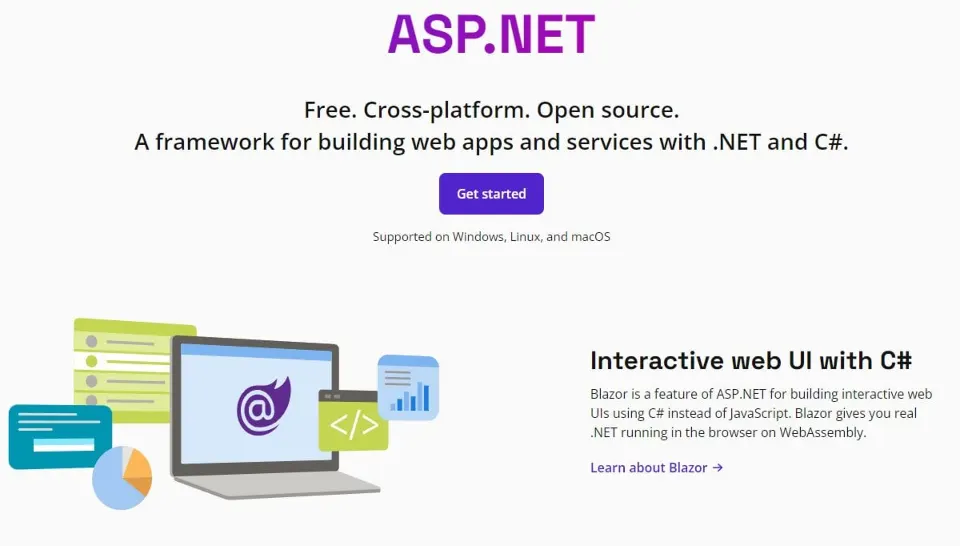
ASP.NET is a "framework within the framework" for developing web applications, allowing developers to build dynamic apps and sites using tools such as ASP.NET Web Forms (now obsolete), ASP.NET MVC and the very popular ASP.NET Core. ASP.NET, which we will look at in more detail below, generally simplifies handling HTTP requests, processing web pages and communicating with relational databases.
6) WinForms
Windows Forms is another framework within .NET, intended for building desktop applications for Windows. With WinForms you can create traditional Windows user interfaces, that is, software (installable if necessary) that runs locally.
7) Windows Presentation Foundation
WPF is a further advanced framework for developing Windows desktop applications with a highly sophisticated user interface. It is ideal for applications that require advanced graphics and an engaging user experience.
8) Xamarin
A framework for developing native mobile apps for iOS and Android using C# and .NET. An excellent choice for building cross-platform smartphone or tablet applications that run on several different platforms.
9) Entity Framework
Entity Framework is an Object-Relational Mapping (ORM) framework that simplifies access to data in relational databases. Developers can work with objects and classes instead of writing SQL queries directly. With EF, connecting to and working with databases is much simpler, more effective and faster.
What are the benefits of .NET? Why choose it?
.NET has many benefits (it is no coincidence that it is among the most used development environments), and covering them all would take rivers of digital ink. Before looking at the general benefits of .NET, we will focus on the most significant ones for those who, like us, specialise in developing web applications and sites: the benefits of what is perhaps its main component, ASP.NET.
A focus on ASP.NET
ASP.NET is extremely easy to configure and use thanks to pre-configurations that mean individual devices do not need to be registered.
Other key features are: the ability to use the programming language (such as C#, J# or VB) best suited to your project, the ability to build complex software with few lines of code, and performance. ASP.NET stands out for its speed compared with other web frameworks on the market.
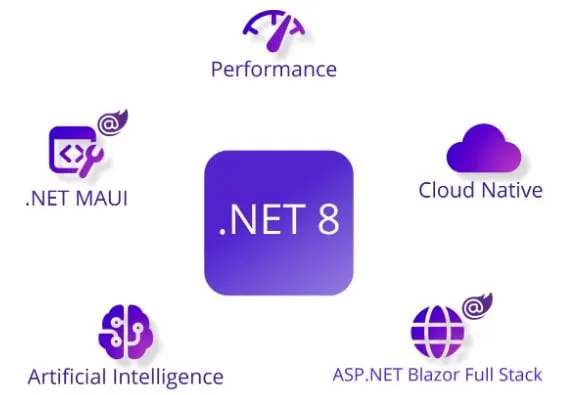
It also performs very well in terms of security, protecting users' data. It includes Razor, a very powerful add-on for building web user interfaces, which will be further enhanced in the upcoming .NET 8 (with an automatic rendering mode for web applications that combines the advantages of Server and WebAssembly rendering in a single dynamic option). Razor also supports sockets for client-server applications and action filters to customise application logic.
Finally, thanks to the unique identification associated with each program, pre-application settings and the Windows authentication mechanism, ASP.NET supports localisation and globalisation, allowing a web application to be accessible all over the world, regardless of linguistic and regional differences.
The general benefits of .NET
.NET, especially thanks to the ASP.NET-Razor duo, is an extremely versatile and powerful environment. In addition, .NET MAUI (the evolution of Xamarin.Forms) makes it possible to develop apps that run on Android, iOS, macOS and Windows from a single shared codebase.
Overall we have identified 6 benefits of .NET that may be useful to you if you decide to adopt it.
1) Interoperability: .NET supports interoperability between languages, so you can use different languages in a single application.
2) Cross-platform: with the introduction of .NET Core it became cross-platform, so you can use it to build software that runs on different platforms.
3) Large community and support: it has a large developer community and provides resources, documentation and tools. Microsoft provides constant support and updates for the framework.
4) Security: it offers advanced tools for application security, including controls for authentication and authorisation, data encryption and threat prevention.
5) Performance: it is known for its excellent performance. The CLR offers efficient memory management and just-in-time (JIT) compilation that improves application performance. A further performance boost appears to be one of the key features of the new .NET 8.
6) Advanced development tools: finally, it works with even more advanced tools (such as Visual Studio) that simplify the development and debugging of applications.
In conclusion
In case it wasn't clear, .NET is an extremely reliable, powerful and flexible software development framework.
As we said, we at ESSE I use it with satisfaction, developing complex, custom software solutions that bring value to our partners' and clients' businesses.
It is also an open source, and therefore free, development platform that you can download for Windows, Linux or macOS today here: https://dotnet.microsoft.com
And here are the installation and usage instructions: https://learn.microsoft.com/en-us/dotnet/core/install/windows
If you decide to use it, or already use it, keep following our blog, or better still subscribe to our free newsletter so you don't miss our articles on coding and IT. Yes, including .NET.
Important
Just as we were finishing and publishing this article, .NET 8 was released! You can download it for free today at this link: https://dotnet.microsoft.com/en-us/download; and here is the announcement: https://devblogs.microsoft.com/dotnet/announcing-dotnet-8/. Keep following us on our social channels too (Facebook, Instagram and above all LinkedIn), where in the coming days we will publish a short post on what's new in .NET 8.