After our article "Debunking 10 myths about programming", we once again take on the role of the MythBusters duo, from the famous popular-science show, to try to overcome a few more IT prejudices. This time the topic is very current: artificial intelligence.
We hope that debunking these myths will help our readers. Especially our clients, some of whom increasingly ask us for software and solutions that integrate this extraordinary technology. Clients who sometimes already know its real potential, while at other times they are just curious and driven by the "artificial intelligence trend".
Because AI is also a fashion, a buzzword, a term that attracts attention and interest and is therefore often abused by the media. As a result, those who ask us to work on a project that integrates it quite often have wrong or unrealistic expectations due to misinformation.
But enough talk! Here are six myths about artificial intelligence to debunk.
1) AI can completely replace human intelligence
AI is designed to perform specific tasks and, although it can outperform humans in some areas, it does not have the holistic understanding, critical judgement and creativity that belong exclusively to human beings.
The very expression "artificial intelligence" may in fact be inaccurate. A more fitting name? Perhaps "simulation of human intelligence".
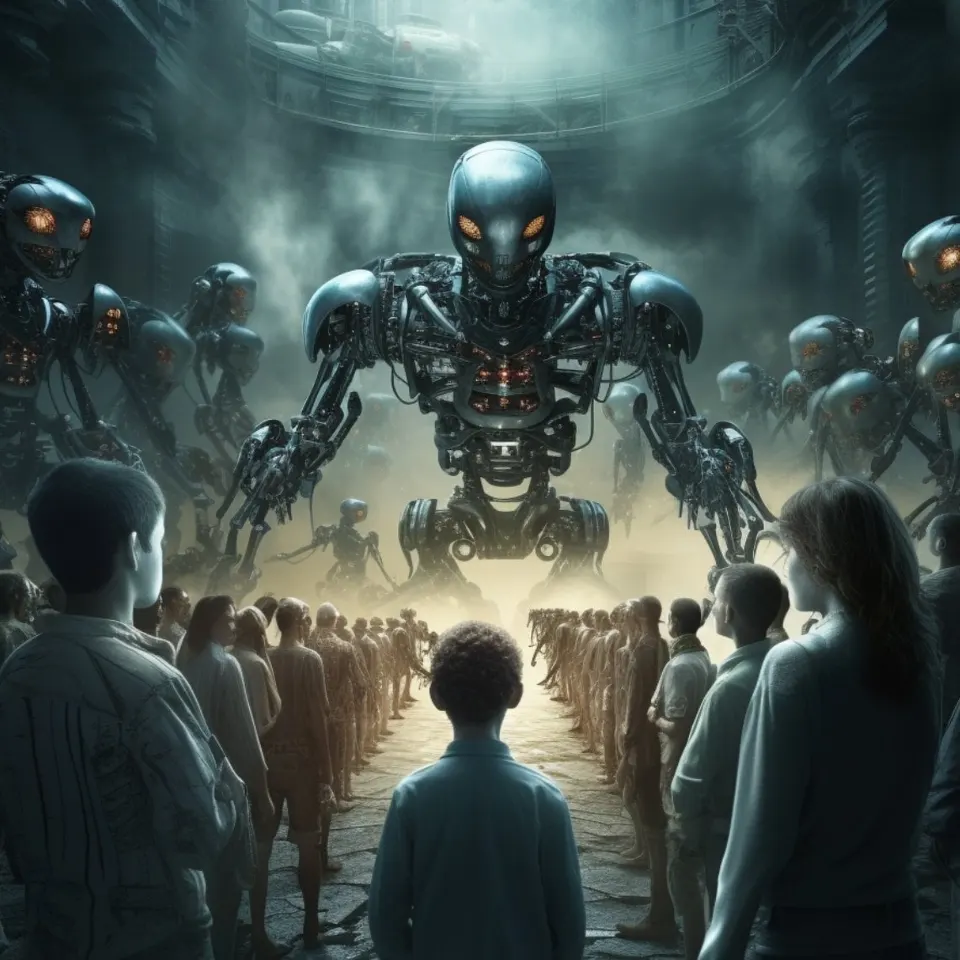
The mistaken idea that AI is equivalent to HI (human intelligence) has helped generate an apocalyptic popular view in recent years, based on extreme speculation by the media. Although concerns about AI ethics are legitimate, the global scientific and technological community is actively working to ensure that AI is developed responsibly and safely.
At present, moreover, AI systems have no self-awareness or consciousness. They work on the basis of algorithms and data, without any real understanding or subjective experience. In practice, they cannot reason autonomously but only carry out tasks assigned by humans, which further contradicts the idea that they could replace us completely.
2) AI will lead to mass unemployment
Again, this is an apocalyptic scenario driven by the "war for attention" that the media fight every day (especially on social media), unfortunately contributing to the spread of fake and distorted news.
AI can certainly automate many tasks, but this does not mean that many jobs will disappear; rather, they will be transformed as AI is integrated into the way they work.
It is probably more correct to say that AI can create new job opportunities and, at the same time, require new high-level skills, but there is no evidence that it will cause mass unemployment. It will certainly cause, and perhaps already has, a substantial change in how we think about work. An ongoing process in which those who have invested in AI work less but better, more productively.
Many professions will not disappear; on the contrary, they may be valued even more. "Personal service" jobs, where the physical human presence makes the difference (thanks to all its peculiarities, virtues and also weaknesses, which are perhaps the most appreciated features), will not be replaced at all.
AI will probably have a "supporting role", as argued on TV in this recent interview with Georg Gottlob, an artificial intelligence expert who holds a chair at the University of Calabria. In other words, many new jobs based on human/machine and human/AI mediation will emerge (and are already emerging).
3) AI can learn and improve without human control
There is a big myth about machine learning: the idea that AI can learn by itself without any need for humans.
In reality, although machine learning allows AI to improve its performance with experience, the process of training and adjusting models requires crucial, continuous human supervision.
But how does it work?
Human supervisors play several key roles that help ensure the effectiveness, reliability and fairness of artificial intelligence models. These roles vary greatly depending on the stage of the machine learning model's life cycle and on the specific context in which it is applied. The most significant include collecting and cleaning data, annotating it, designing and developing the models, evaluating and testing them, monitoring and maintenance and, last but not least, a stage of ethics and governance review.
So, besides being unavoidable, human work on models involves many hours of work. Potentially high-level work, and therefore certainly significant costs.
But we will talk about the costs of AI development, which a widespread prejudice often considers "cheap", in the last myth.
4) AI always works objectively and without bias
AI algorithms can reflect or amplify the biases present in the data they are trained on. This requires careful review and correction to ensure fairness, which is not always fully possible because of the social training involved.
Essentially, when models rely on huge amounts of social data, the degree of subjectivity of the results increases.
A famous and much-debated case concerns a recruitment system used by Amazon in 2014 that showed bias against women: trained on historical hiring data reflecting male predominance in the tech sector, during machine learning it "learned" to penalise CVs containing words such as "woman".
A second well-known case is an MIT study showing that some facial recognition systems had higher error rates for people of colour.
Even better known is the case of the generative image tool Midjourney which, having been trained on images of women and men whose bodies and faces fit Western beauty standards, tends to produce images with similar features, effectively exalting stereotyped figures.
In short, never rely too much on the impartiality of AI-generated results.
5) AI is infallible
Like any technology, Artificial Intelligence can make mistakes, especially when faced with situations not covered by its training data or because of limitations in its algorithms.
Besides the "data bias" problem mentioned above, AI can also fail when faced with situations it has never "seen" in its training data.
For example, a self-driving system might not know how to react to an unusual road event if it was not present in its training dataset.
On top of this there is a limitation of the algorithms, due both to insufficient "contextual understanding" and to insufficient "generalisation".
In the first case, AI algorithms, particularly those based on deep learning, can excel at recognising "patterns in data" but lack a real understanding of context or causality, ending up making wrong or inappropriate predictions.
In the second case, the algorithm may be unable to correctly apply what it has learned from training data when it encounters new data, situations or examples it has never seen before.
So be careful about considering AI infallible: it could cost you dearly.
In 2023, for example, there was much discussion about the New York lawyer representing an airline who had ChatGPT write his legal brief and presented in court "precedents" that never existed, entirely invented by the AI. A real disaster!
6) Implementing AI is cheap
Finally, here is the myth that most embarrasses the sales department of software houses like ours: the ease of use and very low cost with which certain generative AI tools have established themselves on the market in recent years have spread the wrong idea that developing with AI is always cheap.
Although there are indeed many "third-party" AI applications and tools that are not difficult to implement and can benefit even small businesses or projects with limited budgets, developing new solutions that integrate artificial intelligence, especially proprietary ones, may not always be cheap.
The reason has to do with the differences between AI systems, which generally fall into three types:
- Weak (or narrow) AI: specialised in specific tasks, such as customer service via chatbots, but without any understanding or consciousness of its own.
- Strong (or general) AI: theoretically capable of performing any human intellectual task, including understanding and generating natural language. Although its arrival is talked about from 2025, in reality it remains a long-term theoretical goal.
- Machine Learning and Deep Learning: subfields of AI that involve learning automatically from large amounts of data. They underpin many recent advances in NLP (Natural Language Processing).
So the idea that programming with AI is always cheap is a myth because tools like ChatGPT belong to the first type, "weak AI", and can therefore be used in third-party applications via APIs at a lower cost. However, they have limited functionality because the model's training phase is predefined (typically by companies such as OpenAI).
On the other hand, developing a proprietary AI as the basis for custom NLP features can require significant investment in time, resources and money: besides the initial development costs, there are ongoing costs for maintenance, model updates and adaptation to changes in language and document formats. Not to mention the need to involve data science and NLP experts.
Remember too that not all AI systems assist users the way ChatGPT does. Many work almost invisibly, such as those used for marketing that analyse browsing data to suggest targeted content.
In general, most are specialised in specific tasks.
If, for example, we at ESSE I wanted to develop an AI that reads and processes documents (useful in many contexts such as office automation, document management or identity and legal document verification), we would need to create a custom solution meeting very specific needs.
This would mean that the AI would have to be designed and developed specifically for the required task, rather than using a generic solution.
And just demonstrating that an AI project idea is valid and can work as expected (a POC, Proof of Concept) would involve a significant cost in itself!
All this underlines how the initial investment in developing custom AI solutions can be significant, especially in the early stages, when the potential is explored and the effectiveness of a new approach or technology is assessed.
In conclusion
Have we been ruthless? We don't think so, just realistic.
But we don't want to clip the wings of your imagination: artificial intelligence, even if you use the tools provided by third parties, is potentially a killer application that lets you unleash your creativity in many sectors.
All that remains is to remind you that, for a skilled hand to help you implement AI in your next digital project, you know where to find us. For example here, by email or by calling us for a free, no-obligation call.