Artificial Intelligence and Toxicity
Introduction
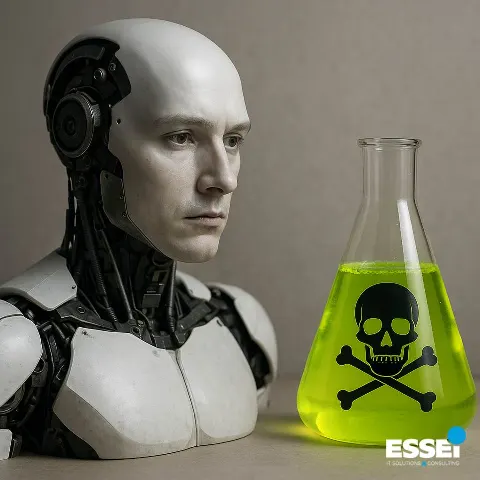
A recent study by researchers from several universities found that artificial intelligence (AI) models are easier to identify when they try to imitate human communication, especially when it comes to toxicity on social media.
The computational Turing test
The research introduced a new approach, called the "computational Turing test", to assess how well AI models can replicate human language. Using automatic classifiers and linguistic analysis, the researchers found that AI models can be identified with 70-80% accuracy when they try to reply to social media posts.
Findings of the study
The researchers tested nine language models, including Llama 3.1 and Mistral 7B, and noticed that these models struggle to replicate the negativity and spontaneous emotional expression typical of human users. The toxicity scores generated by AI were consistently lower than those of genuine user replies.
- The AI models had difficulty maintaining a human-like emotional tone.
- Optimisation techniques did not significantly improve their ability to imitate.
Implications and conclusions
The study also found that instruction-tuned models, trained to follow users' instructions, do not perform better than their non-instruction-tuned counterparts. Moreover, increasing model size did not lead to more authentic communication. The results suggest that AI, in trying to seem more human, can drift away from genuine human expression.
Our interest in Artificial Intelligence
At ESSE I we are constantly working on innovative solutions in the field of artificial intelligence. Our projects aim to improve interaction between people and machines while ensuring cybersecurity and digital accessibility. We are interested in exploring how AI technologies can be optimised for more authentic and meaningful communication.